

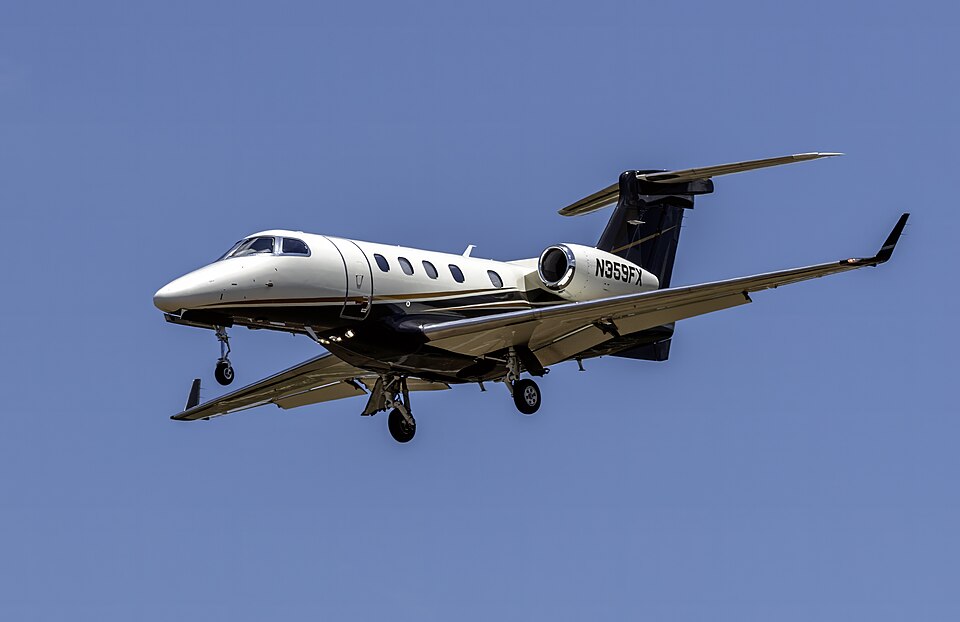
Nextant Aerospace 400XTi
The Nextant 400XTi is a remanufactured Beechjet 400A/XP fitted with new Williams FJ44-3AP engines, Rockwell Collins Pro Line 21 avionics and a redesigned interior, cutting fuel burn by about a third and extending range to 2,003 nm. Around 70 were delivered from 2011, offering near-new light-jet performance at a fraction of new-aircraft prices.
In short: The Nextant Aerospace 400XTi is a Light Jet with a range of 2,003 nm, a cruise speed of 460 knots and room for 7 passengers. Pre-owned examples trade around $2M–$3.2M and costs roughly $1,650 an hour to operate (estimate).
2,003 nm
Range
460 kts
Max cruise
7–8
Passengers
—
New price
Highlights
- Remanufactured with new engines and avionics
- 2,003 nm range and 460 kt cruise
- Roomy Beechjet cabin at used-jet prices
Performance
- Range
- 2,003 nm
- Max cruise
- 460 kts
- Max Mach
- 0.78
- Max altitude
- 45,000 ft
- Takeoff distance
- 3,821 ft
- Landing distance
- 2,960 ft
- MTOW
- 16,300 lb
- Engines
- 2 × Williams FJ44-3AP
- Thrust per engine
- 3,050 lbf
- Fuel burn
- 150 gal/hr
- Avionics
- Rockwell Collins Pro Line 21
Cabin
- Passengers
- 7 / 8
- Cabin length
- 15.5 ft
- Cabin width
- 4.9 ft
- Cabin height
- 4.8 ft
- Cabin volume
- 305 cu ft
- Baggage
- 53 cu ft
- Min. crew
- 2
Economics
- New price
- —
- Variable cost / hr
- $1,650
- Fixed cost / yr
- $520,000
- First delivery
- 2011
- Out of production
- 2020
- Units built
- 70
- Pre-owned range
- $2M – $3.2M
Estimates. Operating costs and pre-owned prices are modelled from industry benchmarks and updated quarterly. Data reviewed 2026-09-13. Sources & methodology.
Dimensions & weights
- Length
- 48.4 ft
- Height
- 13.9 ft
- Max fuel
- 4,912 lb
Programme milestones
- 2010-03First flight · Nextant 400XT first test flight businessairnews.com
- 2011-10Certification · Nextant 400XT FAA certification businessairnews.com
- 2011-10First delivery · First 400XT deliveries, to Flight Options en.wikipedia.org
- 2014-11-07Milestone · 400XTi STC approval from China's CAAC aviationtoday.com
- 2014Announced · Upgraded 400XTi introduced businessairnews.com
Pre-owned range & Residual value curve
Pre-owned range
$2M – $3.2M
Estimates. Operating costs and pre-owned prices are modelled from industry benchmarks and updated quarterly.
Residual value curve
Estimated value retention over 10 years from new, by category depreciation model.
Year 10: 47% ≈ $1.5M
Compare with similar private jets

Compare: 400XTi vs PC-24 vs Phenom 300E vs Phenom 300 →
Related insights

Private Jet vs First Class vs Your Own Car: The Honest Comparison
New York to Miami and London to Nice, three ways: what each costs, how long it takes from door to door, and how much CO2 it puts in the air. The results are less flattering to the jet than you'd think, and less damning than you'd fear.
Sources and credits
- Nextant Aerospace 400XTi · Alec Wilson from Hampton-in-Arden, United Kingdom · CC BY-SA 2.0 · Wikimedia Commons