Can You Afford to Fly Private? A Reality Check by Net Worth and Income
Charter at $1 million liquid, a jet card at $5 million, a fractional share at $30 million, your own aircraft at $100 million. Here are the rules of thumb the industry actually uses, with the arithmetic behind each one.
By JetAtlas · Published 2026-09-01 · 8 min read · How we check facts
Private aviation has a ladder, and each rung has an unofficial price of admission. Brokers, wealth managers, and the operators themselves use rough rules of thumb about who should be flying how, and while nobody is checking your bank balance at the FBO, the rules exist because people who ignore them tend to regret it. Here they are, with the arithmetic.
The framework rests on one principle: flying should be a small, sustainable share of what you have and what you earn, typically 1 to 3 percent of net worth a year for regular flyers, or a defensible slice of after-tax income for occasional ones. The rungs below are where that principle lands for each product.
Rung one: occasional charter, from about $1 million liquid
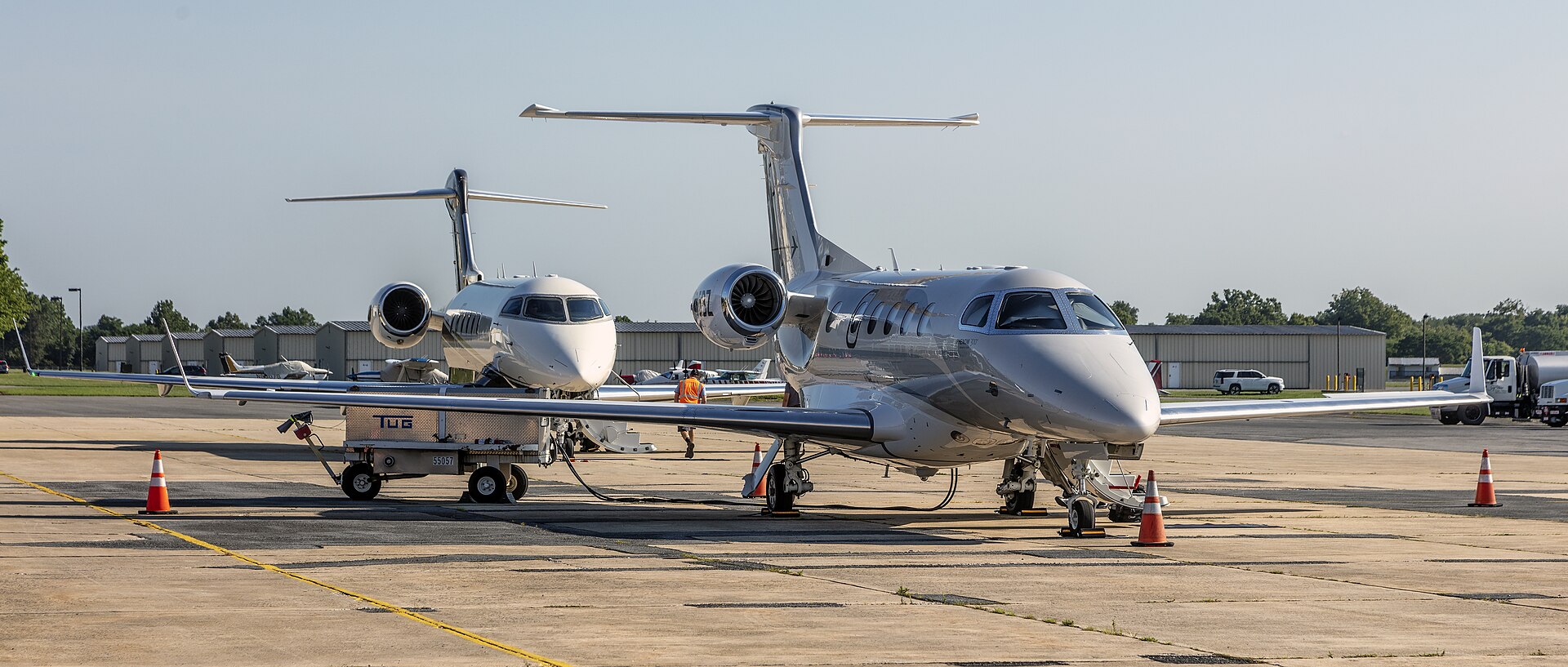
Charter is pay-as-you-go. A light jet is $3,000 to $4,500 an hour, a midsize $4,500 to $8,500, and once you add repositioning, fees, and tax, a realistic two-hour one-way trip on a light jet is $12,000 to $18,000. A round trip for a family holiday, say New York to Nantucket and back on a Phenom 300E, is about $18,000 to $22,000.
The industry's informal threshold for doing this once or twice a year without it hurting is about $1 million in liquid assets (not counting your home) or an after-tax income above $500,000. Two trips at $20,000 is $40,000: 4 percent of $1 million, or 8 percent of $500,000 of take-home pay. That is a lot for a holiday but comparable to what people at that wealth level spend on a car.
Rung two: jet cards, from about $5 million
A jet card is prepaid charter with a guaranteed hourly rate and guaranteed availability. The reference product is NetJets' 25-hour card: in early 2025 the light-jet version cost $215,000 for 25 occupied hours, about $8,600 an hour including federal excise tax, with higher rates for larger aircraft and for cards with fewer blackout dates. Rivals such as Flexjet, Wheels Up, and VistaJet price similarly, with a wide range of terms.
A jet card makes sense for someone flying 25 to 50 hours a year, which is 10 to 20 round trips, and the threshold most advisers cite is $5 million to $10 million in net worth. The arithmetic: $215,000 a year is 4.3 percent of $5 million, or 2.2 percent of $10 million. At 50 hours it is $430,000, and at that point a fractional share starts to look cheaper.
| Rung | Product | Typical annual spend | Suggested minimum | Spend as % of minimum |
|---|---|---|---|---|
| 1 | Occasional charter (2 trips) | $30,000 to $50,000 | $1M liquid or $500k income | 3 to 5% |
| 2 | Jet card (25 hours) | $200,000 to $300,000 | $5M net worth | 4 to 6% |
| 3 | Fractional share (50 hours) | $400,000 to $700,000 | $30M net worth | 1.5 to 2.5% |
| 4 | Whole light jet (Phenom 300E, 300 hours) | $1.5M to $2.5M incl. depreciation | $30M to $50M net worth | 3 to 5% |
| 5 | Whole large-cabin jet (G650ER, 400 hours) | $6M to $9M incl. depreciation | $100M-plus net worth | 6 to 9% |
Spend figures are JetAtlas estimates for 2026, U.S. market, including depreciation where ownership is involved. Thresholds are industry rules of thumb, not requirements.
Rung three: fractional ownership, from about $30 million
Fractional ownership means buying a share of an aircraft (one-sixteenth is the smallest, giving about 50 hours a year for a five-year term) and paying a monthly management fee plus an hourly rate when you fly. A one-sixteenth share of a light jet in 2026 costs roughly $500,000 to $850,000 up front, plus $12,000 to $28,000 a month in management, plus the occupied hourly rate of $3,000 to $5,000. The all-in cost for 50 hours is around $400,000 to $600,000 a year once you account for the share's depreciation (you sell it back at the end, typically at 60 to 70 percent of what you paid).
Because the capital commitment is $500,000 to $2 million and the annual spend is $400,000-plus, advisers usually put fractional at $30 million net worth and up. At that level the annual cost is 1.5 to 2 percent of net worth, which is the range at which most families find it sustainable.
Rung four: your own light or midsize jet, from about $30 to $50 million
A new Phenom 300E is about $12 million; a Citation CJ4 Gen2 about $11 million; a five-year-old example of either about $7 million to $9 million. Fixed costs (two pilots, hangar, insurance, management, training) run about $700,000 to $1 million a year regardless of use. Variable costs are about $2,000 to $2,500 an hour. At 300 hours a year, that is roughly $1.4 million to $1.8 million in cash, plus depreciation of $600,000 to $900,000 a year on a new aircraft.
The two rules of thumb that matter here: the aircraft's price should be no more than 10 to 15 percent of net worth (so a $12 million jet implies $80 million to $120 million, though many owners stretch this on a used aircraft), and you should be flying at least 200 to 300 hours a year, because below that fractional or a card is cheaper. Owners at this level are typically business owners who can put the aircraft to work, with charter revenue when they are not using it.
Rung five: a large-cabin jet, $100 million-plus
A Gulfstream G650ER costs about $70 million new; a G700 about $79 million; a Global 7500 similar. Fixed costs are $2.5 million to $3.5 million a year (three to four pilots, a cabin attendant, a large hangar, training, insurance on a $70 million hull). Variable costs are $5,000 to $7,000 an hour. At 400 hours, cash costs are $5 million to $6 million a year, and depreciation adds $3 million to $5 million in the early years.
At $8 million a year, the 2 to 3 percent sustainability rule implies a net worth of $250 million to $400 million, and the 10 to 15 percent aircraft-value rule implies $500 million or more. The industry's shorthand is $100 million, which is more of a floor than a comfortable level; in practice, most ultra-long-range jets are owned by companies, governments, or people with net worth well into the hundreds of millions.
The income lens
Net worth is the industry's preferred yardstick because flying is a discretionary expense that people fund from capital, not salary. But an income test catches people who are cash-rich and asset-poor, or the reverse:
- Charter a couple of times a year: after-tax income of $500,000-plus, spending under 10 percent of it.
- Jet card: after-tax income of $2 million-plus, spending 10 to 15 percent.
- Fractional: after-tax income of $3 million-plus.
- Whole aircraft: income is the wrong lens; the question is capital and whether the aircraft earns its keep.
The honest questions to ask first
- How many hours will you really fly? Almost everyone overestimates. Track a year of trips and count the ones where private would have made a genuine difference.
- Are you paying for time or for the experience? Business users can justify a jet on billable hours. Holiday users are buying comfort, which is fine, but the accounting is different.
- Is your wealth liquid? A founder with $50 million in company stock and $400,000 in the bank is not a fractional customer.
- Can you walk away? Charter has no commitment. Cards run a year or two. Fractional runs five years. A jet is yours until you find a buyer.
The most common piece of advice from people inside the industry is simply to start one rung lower than you think you belong. Charter before you buy a card. Buy a card before you buy a share. Own a share before you own a jet. Each step teaches you how much you really fly, and the answer is nearly always less than the brochure assumed.
Mentioned in this story
More insights

What luxury really means on a VIP airliner
A VIP airliner is not just a larger private jet. Its real luxury is measured in certified space, sleep, quiet systems, completion time, crew workflow and the ability to carry a household or delegation across oceans without turning the cabin into theatre.
Farnborough, Biggin Hill or Luton: choosing a London private jet airport
Compare the final ground destination, operating window, aircraft requirements and handling arrangements before choosing a London airport.
Teterboro, Westchester or Morristown: choosing a New York private jet airport
Compare the airport and ground destination together, then check handling, timing, noise requirements and a fallback before accepting a charter proposal.