The World's Most Famous Private-Jet Airports, and Why the Rich Land There
Teterboro handled 75,000 private departures last year and bans anything over 100,000 pounds. St Barts has a 2,100-foot runway that no jet can use. A tour of eight airports that explain how private aviation actually moves.
By JetAtlas · Published 2026-08-25 · 7 min read · How we check facts
Airlines go where the passengers are. Private jets go where the passengers want to be, which is a different map: closer to the city, closer to the ski lift, closer to the yacht. The airports on that map are mostly small, often old, sometimes dangerous, and in a few cases more famous than the cities they serve. Here are eight of them, with the numbers that explain why they matter.
Teterboro, New Jersey (TEB)
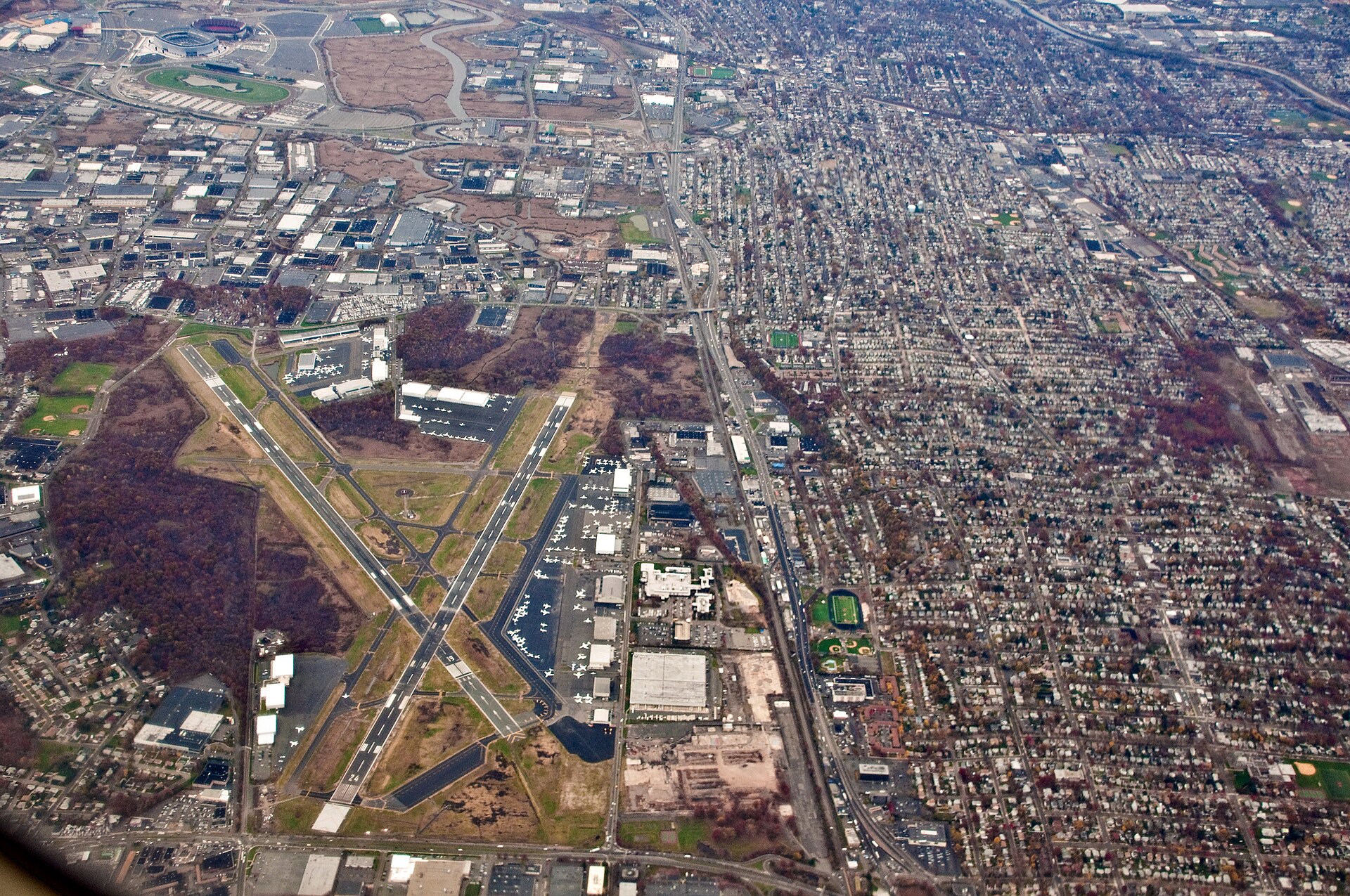
Twelve miles from Times Square, Teterboro is the busiest private-jet airport in the world. WingX counted 75,029 business-jet departures in 2025, more than any other U.S. airport and roughly 200 a day. It opened in 1919, has no airline service, and is governed by a rule that shapes everything: no aircraft over 100,000 pounds. That keeps out airliners and VIP Boeings; the biggest regular visitors are Gulfstream G650s and Global 7500s, which sneak under the limit.
Teterboro also has a voluntary restraint on non-essential flights between 11 p.m. and 6 a.m., which operators mostly observe because the alternative is a mandatory curfew. The ramp is a study in economics: during Fashion Week, the U.N. General Assembly, and the big finance conferences, parking runs out, and aircraft that drop passengers off are sent to White Plains or Morristown to wait.
Van Nuys, California (VNY)
Los Angeles's private airport sits in the San Fernando Valley, 20 minutes from Beverly Hills in good traffic. It has been the West Coast's answer to Teterboro since the 1960s, with a ramp famous for the aircraft of studios, agencies, and the entertainment industry. In 2025 it slipped to ninth in U.S. departures after a 12.3 percent decline, which analysts attribute partly to the January 2025 fires that destroyed more than 11,000 homes on the west side of the city. It is still the airport where a G650 parked next to a Global next to a BBJ is unremarkable.
Paris-Le Bourget (LBG)
Europe's busiest business airport, with 54,724 movements in 2024, about 92 percent of French business-aviation traffic. Le Bourget was Paris's main airport until Orly opened, and it is where Charles Lindbergh landed in 1927 at the end of the first solo transatlantic flight. Today it hosts the Paris Air Show in odd-numbered years and, the rest of the time, a dozen FBOs serving the Gulf, Africa, and the fashion and luxury industries. It is 11 kilometres from the centre of Paris, closer than either Charles de Gaulle or Orly.
London Farnborough (FAB)
The site of Britain's first powered flight (Samuel Cody, 1908) and of the Farnborough Airshow is also London's purpose-built business airport, about an hour from central London and capped by planning rules at 50,000 movements a year; it handles roughly 24,000. Its terminal is a swooping piece of modern architecture that looks like something Norman Foster might have designed had he been asked, and its slot discipline makes it the preferred London airport for large-cabin jets. Luton, Biggin Hill, and Stansted carry the rest of London's private traffic.
Nice Côte d'Azur (NCE)
Europe's second-busiest business-aviation hub, and the most glamorous. Nice sits on the coast between Cannes and Monaco, and its dedicated business-aviation terminal, opened in 2010, has helicopter connections to Monaco in seven minutes. Traffic peaks at the Cannes Film Festival, the Monaco Grand Prix, and the Monaco Yacht Show, when the ramp is a catalogue of everything from Phenoms to ACJ320s and parking is negotiated days ahead. Business movements across Nice, Cannes-Mandelieu, and Saint-Tropez rose 4 percent in 2025.
Aspen-Pitkin County, Colorado (ASE)
Aspen is 7,820 feet above sea level, sits in a box canyon, and requires pilots to be specially briefed on its approach, which involves descending steeply between mountains and landing on a single runway with no go-around straight ahead. It is also restricted to aircraft with a wingspan of 95 feet or less, because the runway and taxiway are too close together. That excludes the Gulfstream G650 (99 feet 7 inches) and Global 7500 (104 feet), which is why Aspen's Christmas ramp is full of Challengers, Falcons, and G550s rather than the biggest jets. A ballot-box argument over whether to widen the airport has run for a decade.
St Barts, Gustaf III (SBH)
The most photographed approach in the Caribbean and, for jets, useless. The runway at St Barts is 2,100 feet long, ends on a beach, and is approached over a hill so close that aircraft descend at a steep angle over the road. No jet can use it; the airport is served by Twin Otters, Cessna Caravans, and Pilatus PC-12s from St Maarten, 10 minutes away, where the jets land. The wealth of St Barts arrives by Gulfstream to St Maarten's Princess Juliana airport and finishes the journey in a nine-seat turboprop or a boat.
Dubai Al Maktoum (DWC)
The newest name on the list. Dubai's second airport, in the Dubai South development, houses the Mohammed bin Rashid Aerospace Hub and a VIP terminal that the emirate describes as the largest purpose-built private-aviation terminal in the world, with its own customs, immigration, and ramp access. Business-jet traffic has grown steadily as Dubai's main airport fills up, and in 2025 Dubai South announced a VIP Terminal Boulevard, a 769-metre strip of 16 buildings for operators and services, to be built from 2026. When Dubai eventually moves all airline traffic to Al Maktoum, its private terminal will already be there.
The airports in numbers
| Airport | City | Business-jet activity | The rule that defines it |
|---|---|---|---|
| Teterboro | New York | 75,029 departures (2025), U.S. #1 | 100,000 lb weight limit; 11 p.m. to 6 a.m. voluntary restraint |
| Van Nuys | Los Angeles | U.S. #9 in 2025 after a 12.3% drop | Noise limits; no airline service |
| Le Bourget | Paris | 54,724 movements (2024), Europe #1 | Business-only since 1981 |
| Farnborough | London | about 24,000 movements | Capped at 50,000 movements a year |
| Nice | Riviera | Europe #2 hub | Shared with 14 million airline passengers |
| Aspen | Colorado | Seasonal peaks at Christmas | 95 ft wingspan limit; 7,820 ft elevation |
| St Barts | Caribbean | Turboprops only | 2,100 ft runway |
| Al Maktoum | Dubai | Fastest-growing in the Gulf | Purpose-built VIP terminal |
Honourable mentions
- Geneva (GVA): the banking and ski gateway, and one of Europe's four big business hubs alongside Le Bourget, Luton, and Nice
- Palm Beach (PBI): the winter capital of American private aviation, now sharing traffic with Fort Lauderdale
- Ibiza and Mykonos: summer ramps so crowded that operators drop passengers and reposition to the mainland
- Scottsdale (SDL): the Super Bowl and Phoenix Open airport, with more Gulfstreams per week in February than most capitals see in a year
- Seletar (XSP): Singapore's business airport, the hub for South-East Asian large-cabin traffic
What they have in common
Three things make a private-jet airport. First, proximity: Teterboro, Le Bourget, and Van Nuys are all closer to their city centres than the airline airports. Second, exclusion: weight limits, wingspan limits, movement caps, and short runways all keep the traffic small and the ramp calm, which is the product being sold. Third, an FBO culture that treats the aircraft as the customer: fuel, hangarage, customs, cars on the ramp, and a lounge where nobody asks for a boarding pass.
The exceptions prove the rule. Palm Beach International, long the second-busiest private airport in America, fell to fourth in 2025 with an 18.3 percent decline, because temporary flight restrictions around Mar-a-Lago when the president is in residence pushed traffic to Fort Lauderdale, which gained 17.6 percent. Private aviation goes where the friction is lowest, and it moves fast when the friction changes.
Mentioned in this story
More insights

What luxury really means on a VIP airliner
A VIP airliner is not just a larger private jet. Its real luxury is measured in certified space, sleep, quiet systems, completion time, crew workflow and the ability to carry a household or delegation across oceans without turning the cabin into theatre.
Farnborough, Biggin Hill or Luton: choosing a London private jet airport
Compare the final ground destination, operating window, aircraft requirements and handling arrangements before choosing a London airport.
Teterboro, Westchester or Morristown: choosing a New York private jet airport
Compare the airport and ground destination together, then check handling, timing, noise requirements and a fallback before accepting a charter proposal.