Drinks on Board: Wine, Champagne, Coffee and Water at Cabin Altitude
A pressurised cabin dulls sweetness, strips the fruit from light wines, flattens champagne faster and makes water boil below 100°C. What that means for the bar on a private jet, and the strict alcohol rules that apply to the crew.
By JetAtlas Editors · Published 2026-09-12 · 5 min read · How we check facts
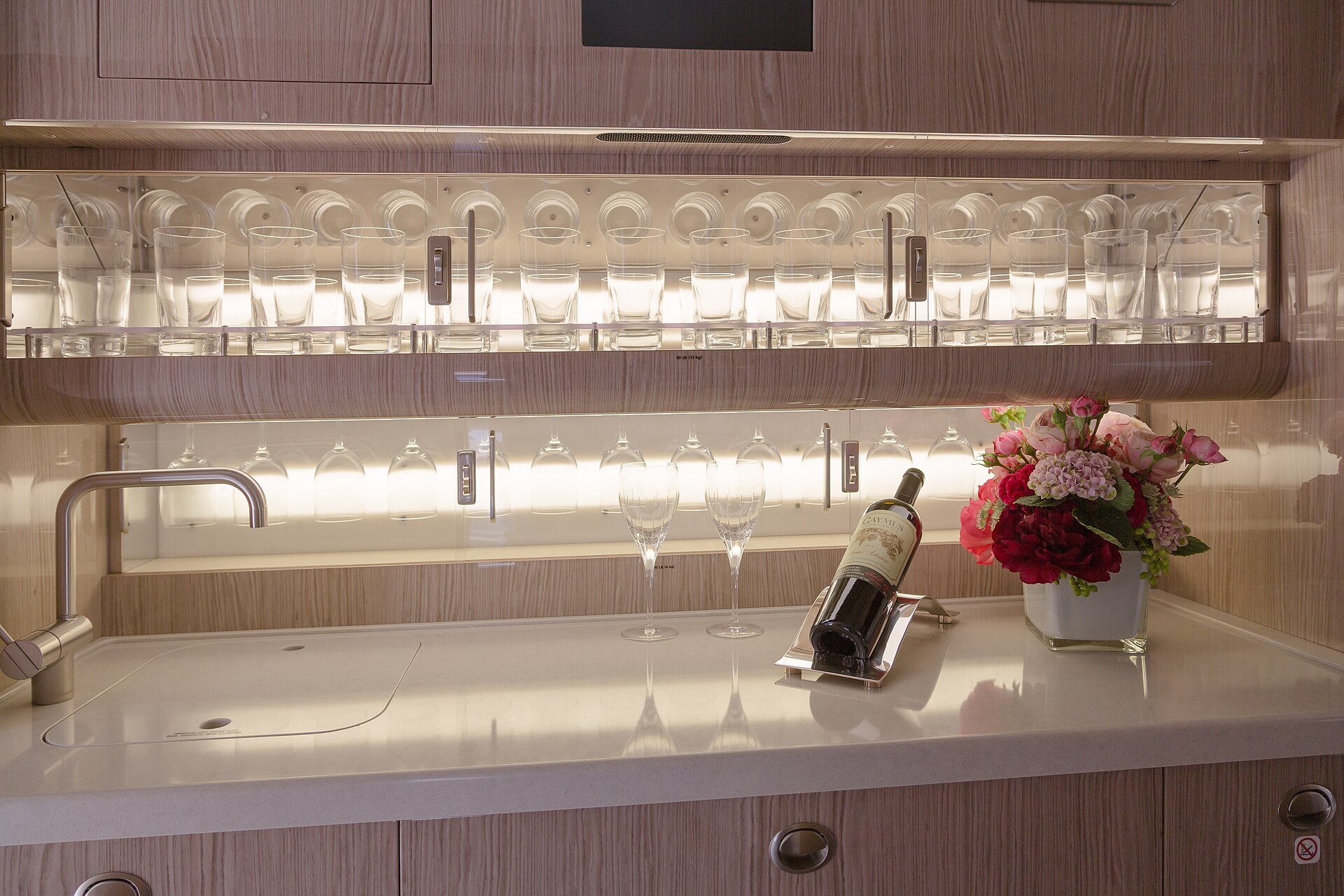
In 2008 a team led by Florian Mayer poured six wines for tasters in two settings. One was an ordinary room at ground pressure, 95 kPa. The other reproduced an airliner at cruise: 76 kPa, the equivalent of about 8,000 feet, with dry air, vibration and engine noise. The tasters still preferred the expensive bottles to the supermarket ones. But every wine tasted thinner and less fruity in the simulated cabin.
That work, carried out at the Fraunhofer Institute's flight-test facility in Germany, is one reason airlines and private operators choose wine the way they do. It also explains why the same bottle can seem like two different drinks on the ground and at 41,000 feet.
What the cabin does to the palate
Three things change at once: air pressure falls, humidity collapses and the background noise never stops. Research has linked each of them to weaker taste and smell.
- Pressure. In the Fraunhofer tests, perceived sweetness and saltiness fell by as much as 30 percent. AeroTime, reporting on the research Lufthansa commissioned, puts salt 20 to 30 percent lower and sugar 15 to 20 percent lower, with acidity largely unchanged.
- Dryness. Without humidification, the air in a large business jet or VIP airliner can drop below 5 percent relative humidity, according to the Swedish humidifier maker CTT Systems. A dry nose detects fewer aromas, and much of what people call flavour is smell.
- Noise. Cabin noise averages around 85 decibels, and a 2011 study found that loud white noise reduced the perception of sweetness and saltiness.
Estimates of the overall loss vary. Business Jet Traveler put it at about 10 percent; the Fraunhofer figures reach 30 percent for particular tastes. The studies agree on the direction: fruit and sweetness fade first, acidity and tannin hold.
| Taste or aroma | Change in a simulated cabin |
|---|---|
| Saltiness | 20 to 30 percent weaker |
| Sweetness | 15 to 30 percent weaker |
| Acidity | Largely unchanged |
| Fruity esters (berry, stone fruit) | Much less intense |
| Oak-derived vanilla notes | Far less affected |
Which wines survive
The Fraunhofer tasters found that fruity esters, the compounds behind berry and stone-fruit notes, were perceived as much less intense in the cabin, while vanilla-like lactones from oak barrels were far less affected. Light styles suffered more than big, full-flavoured ones.
That matches what cabin-wine buyers recommend. A Business Jet Traveler panel that included buyers from the caterer Air Culinaire and the wine merchant Sokolin favoured bold reds such as Cabernet Sauvignon and Zinfandel, and whites with oak ageing, minerality and good acidity. A delicate Pinot Noir or a light Riesling that shines on the ground can taste hollow in the air.
Savoury flavours are the exception. Charles Spence, an Oxford professor who studies perception, has suggested that umami resists cabin noise, which may explain the airborne popularity of tomato juice and Bloody Marys.
Champagne and lower pressure
A sealed bottle is not at risk. Glass is rigid, and a bottle of champagne already holds far more pressure than the small difference between the ground and a pressurised cabin.
Once the cork is out, things change. The lower cabin pressure lets carbon dioxide leave the wine faster, so it foams harder when poured and goes flat sooner. Research published in the Proceedings of the National Academy of Sciences linked the rate at which champagne bubbles burst to how its flavour is perceived. In a cabin, bubbles burst faster and the aromas they carry dissipate sooner, so the last third of a glass is noticeably flatter than the first.
Coffee, tea and water
Hot drinks run into simple physics. Water boils at a lower temperature as pressure falls, about 1°F lower for every 500 feet of altitude. In an 8,000-foot cabin it boils at about 197°F (91.5°C), so tea made with just-boiled water brews weaker than it would at home. Business Jet Traveler's report on galley cooking noted the same effect on boiled and braised dishes.
| Setting | Cabin altitude | Water boils at (approx.) |
|---|---|---|
| Ground at sea level | 0 ft | 212°F (100°C) |
| Older airliner at cruise | up to 8,000 ft | 197°F (91.5°C) |
| Boeing 787 or Airbus A350 | about 6,000 ft | 201°F (94°C) |
| Gulfstream G700 at 41,000 ft | 2,840 ft | 206°F (97°C) |
| Bombardier Global 8000 at 41,000 ft | 2,691 ft | 207°F (97°C) |
Galley equipment is built around these limits. Enflite makes a business-jet coffee maker that brews 1.5 litres, weighs 7.3 kg and needs no plumbing. Iacobucci HF Aerospace, an Italian company that has supplied aviation for more than 50 years, makes espresso machines and induction ovens for aircraft galleys.
Water is the most important drink on board. With humidity so low, passengers lose moisture through breathing and skin, which is why crews keep offering it and why humidifiers have become a selling point on VIP airliners. CTT says its system lifts cabin humidity from below 5 percent to between 20 and 23 percent.
The bar
On a light jet there is usually no cabin attendant, and drinks come from a small cabinet that passengers open themselves. On a large-cabin jet the bar is part of the galley, with ice drawers and chilled storage. On a VIP airliner it can be a room of its own: a Boeing Business Jet refurbished by VIP Completions and unveiled in February 2024 has a mid-cabin galley with a bar area that opens onto the main lounge.
The rules for crew and passengers
For pilots, U.S. rules are blunt. Under 14 CFR 91.17, nobody may act as a crewmember within 8 hours of drinking alcohol, or with a blood or breath alcohol concentration of 0.04 or more. The same rule bars a pilot from carrying a passenger who appears intoxicated, except in an emergency.
Charter flights add a second layer. Under 14 CFR 135.121, a passenger on a charter aircraft may drink only alcohol served by the operator; the operator may not serve anyone who appears intoxicated, and may not let an intoxicated person board. That is why a charter crew pours the champagne a passenger brought rather than simply handing over the bottle. On an owner's own aircraft flown privately under Part 91, the charter rule does not apply. The 8-hour rule for the pilots applies on every flight.
Sources
- VinePair: is there science behind wine tasting different at 35,000 feet?
- AeroTime: why champagne tastes different on a plane
- Business Jet Traveler: 9 cabin-worthy wines
- 14 CFR 91.17, alcohol or drugs (Cornell LII)
- 14 CFR 135.121, alcoholic beverages (Cornell LII)
- CTT Systems: ACJ320 with enhanced humidification
More insights
Food at 45,000 Feet: How Private-Jet Catering Actually Works
Almost nobody cooks on a private jet. Meals are made on the ground, chilled, delivered about 90 minutes before departure and finished in a galley the size of a wardrobe. Who does the work, why food tastes different up there, and how one sandwich reached $177.
Sleeping on a Private Jet: Real Beds, Thinner Air and the Pilots Who Take Turns
Most private jets make beds out of seats. The largest now have fixed bedrooms, cabins pressurised below 3,000 feet and lights that imitate sunrise. What actually helps passengers sleep, and where the pilots rest on a 15-hour flight.
The Galley: How a Private-Jet Kitchen Fits in a Cupboard
A business-jet galley has to fit a refrigerator, ovens and a coffee machine into the space of a wardrobe, survive crash loads and run on aircraft power. What is inside, what it weighs, and what a flight attendant can really cook.