How Private Jets Handle Turbulence and Storms
Private jets do not defeat bad weather so much as plan around it: crews use forecasts, radar, air traffic help and conservative cabin procedures to keep storms off the nose and passengers in their seats. The aircraft’s altitude, wing, avionics and operating rules all matter, but the simplest protection remains a fastened belt.
By JetAtlas · Published 2026-10-06 · 8 min read · How we check facts

The FAA’s turbulence injury table, updated on March 20, 2026, lists 207 serious injuries on U.S. Part 121 airline flights from 2009 through 2024. Only 40 were passengers. The larger number, 166, were crew members, often hurt because their work puts them in the aisle when the air turns rough.
That number explains a quiet truth about turbulence in private aviation. The airplane is usually not the fragile part of the system. The cabin is. A loose laptop, a crystal glass, a standing passenger or a flight attendant pouring coffee can become the real hazard long before the wing is in trouble.
Private jets handle turbulence and storms through avoidance first, procedure second and aircraft design third. The smoothest ride is often the one that leaves 100 miles of storm line off the wingtip, lands 40 minutes late, or stops for fuel because the safer route is longer.
The airplane is built for loads, not comfort
A certified business jet is designed to tolerate far more stress than passengers want to feel. Moderate turbulence can feel violent in the cabin, yet still be well inside the aircraft’s structural margins. Severe turbulence is different: it can throw unsecured people and objects, make altitude hard to hold, and trigger a maintenance inspection after landing.
Pilots therefore do not treat turbulence as a test of toughness. They slow to the aircraft’s published rough-air or turbulence penetration speed when needed, secure the cabin, and use the procedures in that aircraft’s flight manual. In very rough air, the goal is not to hold a perfectly smooth altitude line. Chasing every bump can add unnecessary control inputs and stress.
The passenger experience, though, depends on the aircraft. A long-range Gulfstream at the upper flight levels has more altitude choices than a turboprop at 25,000 feet. A light jet can slip into smaller airports, but it may have fewer layers of airspace available above summer buildups. None of that makes one category unsafe. It changes the menu of options.
| Aircraft | Typical passengers | Max cruise | Ceiling | Range |
|---|---|---|---|---|
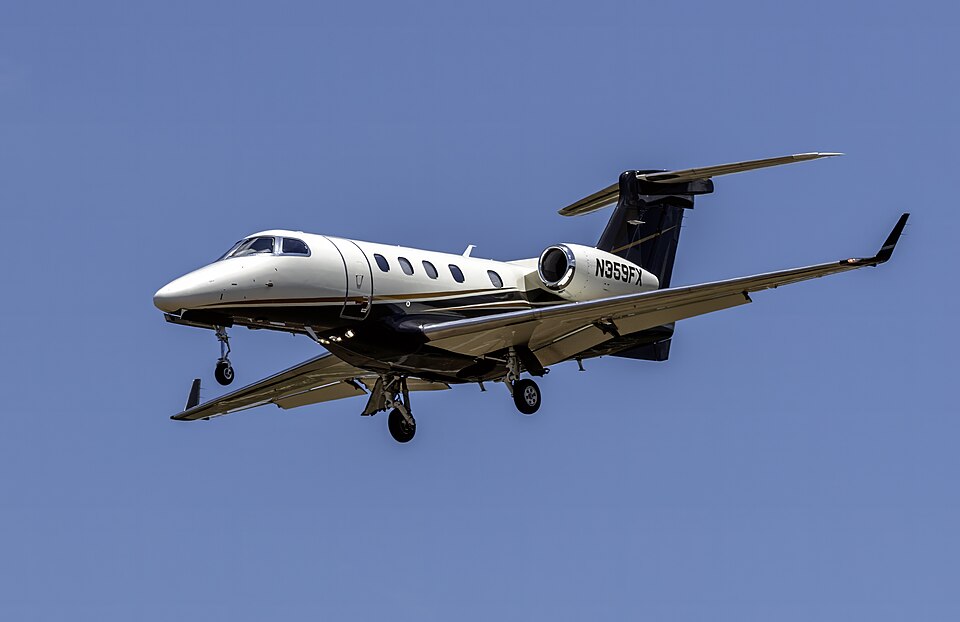
| Embraer Phenom 300E | 6 | 464 kt | 45,000 ft | 2,010 nm |
| Citation Latitude | 8 | 446 kt | 45,000 ft | 2,700 nm |
| Gulfstream G700 | 13 | 516 kt | 51,000 ft | 7,750 nm |
| Beechcraft King Air 360 | 7 | 312 kt | 35,000 ft | 1,806 nm |
| Pilatus PC-12 NGX | 6 | 290 kt | 30,000 ft | 1,803 nm |
Altitude matters because weather has shape. Some clouds top out below a jet’s cruise level. Thunderstorms do not always oblige. A mature cumulonimbus can climb into the high flight levels, throw hail away from the visible cloud, and disturb air well beyond the rain shaft. The correct response is not to climb through it. It is to go around.
Storms are planned around, not punched through
A private jet trip in convective weather begins on the ground: dispatch software, aviation forecasts, radar mosaics, pilot reports, NOTAMs, airport conditions, fuel planning and alternate airports. Under U.S. rules, many private flights operate under Part 91, while charter flights operate under Part 135. The practical habits of a good crew are similar: look ahead, leave an exit, and do not let the passenger schedule become the weather plan.
NBAA’s Business Aviation Insider has described how corporate flight departments use tools such as the Aviation Weather Center’s Traffic Flow Management Convective Forecast, graphical aviation forecasts, National Hurricane Center products and Storm Prediction Center outlooks. Those products shape decisions before the airplane moves: depart earlier, wait out a line, file a route around constrained airspace, add fuel, or choose a different airport.
Good crews ask several concrete questions:
- Are there convective SIGMETs, squall lines, embedded cells, hail reports or strong tops along the route?
- Is the line moving faster than the planned flight can outrun or outflank?
- Will air traffic control likely issue reroutes or ground delays?
- Is there enough fuel for a wider deviation and a proper alternate?
- Can the cabin service be finished early, before the rough section begins?
- Does the destination have wind shear, lightning, standing water or hail risk on the ramp?
The private jet advantage is flexibility. A business aircraft can often use a secondary airport away from the worst weather, hold passengers in the FBO rather than board into a known cell, or leave at dawn before heat builds thunderstorms over the route. The disadvantage is that smaller operations may have less dispatch depth than an airline unless they deliberately buy or build that support.
The 20-mile habit
The FAA’s thunderstorm guidance is blunt: avoid by at least 20 miles any thunderstorm identified as severe or showing an intense radar echo, especially under the anvil of a large cumulonimbus. The reason is simple. The worst air is not always painted where the rain looks worst, and hail or violent turbulence can sit outside the neat edge of a cockpit display.
That is why pilots dislike the passenger phrase “fly through the storm.” Airplanes may fly through rain. They may descend through cloud. They may land in poor visibility with the proper equipment and legal minima. A thunderstorm cell is a different animal: updrafts, downdrafts, wind shear, lightning, icing, hail and extreme precipitation in one machine.
If a line has a clean gap, crews still treat it with suspicion. Ground-based radar sent by datalink can be old by the time it reaches the cockpit screen. A gap shown on a display may have narrowed, moved or filled. Airborne radar helps because it looks forward from the aircraft in real time, but it is not magic. It sees precipitation, not invisible clear-air turbulence.
What the cockpit can see
Modern business jets carry layers of weather information. Datalink weather gives strategic context beyond the aircraft’s radar range. Airborne radar gives tactical information ahead. Satellite communications can bring updated flight plans and weather packages. Air traffic control can relay pilot reports and help approve deviations.
The technology is improving. Honeywell’s IntuVue RDR-4000 uses 3-D volumetric scanning and is listed with a 320 nm maximum detection range and coverage from the ground to 60,000 feet. Honeywell’s RDR-7000 page describes real-time 3-D scanning to 320 nm, automatic tilt and gain, and hazard detection for turbulence, windshear, hail and lightning up to 60 nm. Dassault’s Falcon 6X background material describes an automatic 3-D color weather radar with predictive lightning and hail detection and 60 nm Doppler turbulence detection.
Forecasting is also becoming more data-driven. The FAA’s turbulence program describes Graphical Turbulence Guidance products, aircraft-derived eddy dissipation rate reports, radar-based turbulence detection and a beta turbulence nowcast that updates every 15 minutes over the continental United States. The important shift is from subjective radio calls alone toward more objective reports from aircraft sensors.
Even so, clear-air turbulence remains difficult because there may be no cloud, no rain and no visible warning. Jet streams, mountain waves and sharp wind gradients can produce a sudden slap in blue sky. In those cases, the belt sign and cabin discipline matter as much as the avionics.
What passengers notice
Inside the cabin, turbulence management is practical rather than dramatic. The crew may ask passengers to sit earlier than expected, pause hot drinks, lock the galley, secure club tables and check that bags are latched. On a private flight, the lead passenger may hear a plain explanation: rough air ahead for 15 minutes, service will stop, belts on until called.
The best passengers make that easy. A private cabin invites movement: conference table, lavatory, divan, galley, baggage access. Those comforts also create exposure. A seat belt worn loosely at the hips is the cheapest safety system on the aircraft.
Pets should be secured before the bumps start. Children belong in approved restraints rather than on laps when turbulence is expected. Heavy items should be in drawers, closets or baggage compartments. A wine bottle on a credenza is not cabin décor in rough air. It is a projectile.
Why some jets feel smoother
Ride quality is part physics, part flight planning and part perception. Heavier aircraft with longer wings often feel less twitchy in small-scale chop. Flexible wings can absorb some motion. Digital flight controls may damp certain responses. Dassault says the Falcon 6X digital flight control system works on autopilot to smooth control response in turbulence. Gulfstream’s large-cabin jets offer high cruise ceilings, giving crews more room to search for a better layer.
But no private jet cancels the atmosphere. A 51,000-foot ceiling does not guarantee a smooth ride at 51,000 feet. Flying higher can help, hurt or simply move the airplane into a different kind of wind. Pilots choose altitude after weighing ride reports, fuel burn, winds, traffic, temperature and the aircraft’s weight at that point in the flight.
The real luxury is not pretending the weather is absent. It is the ability to wait in a quiet lounge while a red line of storms crosses the field, then board after the ramp lights stop flashing and the belt buckles lie flat against the leather seats.
Sources
Mentioned in this story
More insights
What a jet card really costs versus charter
Jet cards buy price certainty, not automatic savings. The real comparison with on-demand charter turns on minimums, peak days, repositioning, taxes, aircraft category and the cost of tying up cash.

Inside the training of a business-jet flight attendant
Business-jet flight attendants train for far more than polished service: fire, smoke, medical events, ditching, evacuation, food safety and the oddities of each cabin. The job is often optional by regulation on smaller jets, but the training is built around the moment when the pilots are busy and the cabin has to act.

The best private-jet airports for skiing
A practical guide to the mountain airports that work best for private-jet ski trips, from Aspen and Telluride to Samedan, Sion and Chambéry. The strongest choices are not always the closest runway, but the airport that balances terrain, weather, aircraft performance and the drive to the lifts.