Best Light Jets 2026: Phenom 300E vs Citation CJ4 Gen2 vs HondaJet Elite II vs PC-24
Four very different answers to the same question. We compare the best-selling light jet, the Citation workhorse, the efficient outlier and the Swiss all-rounder on cabin, performance, cost and resale.
By JetAtlas · Published 2026-07-16 · 8 min read · How we check facts
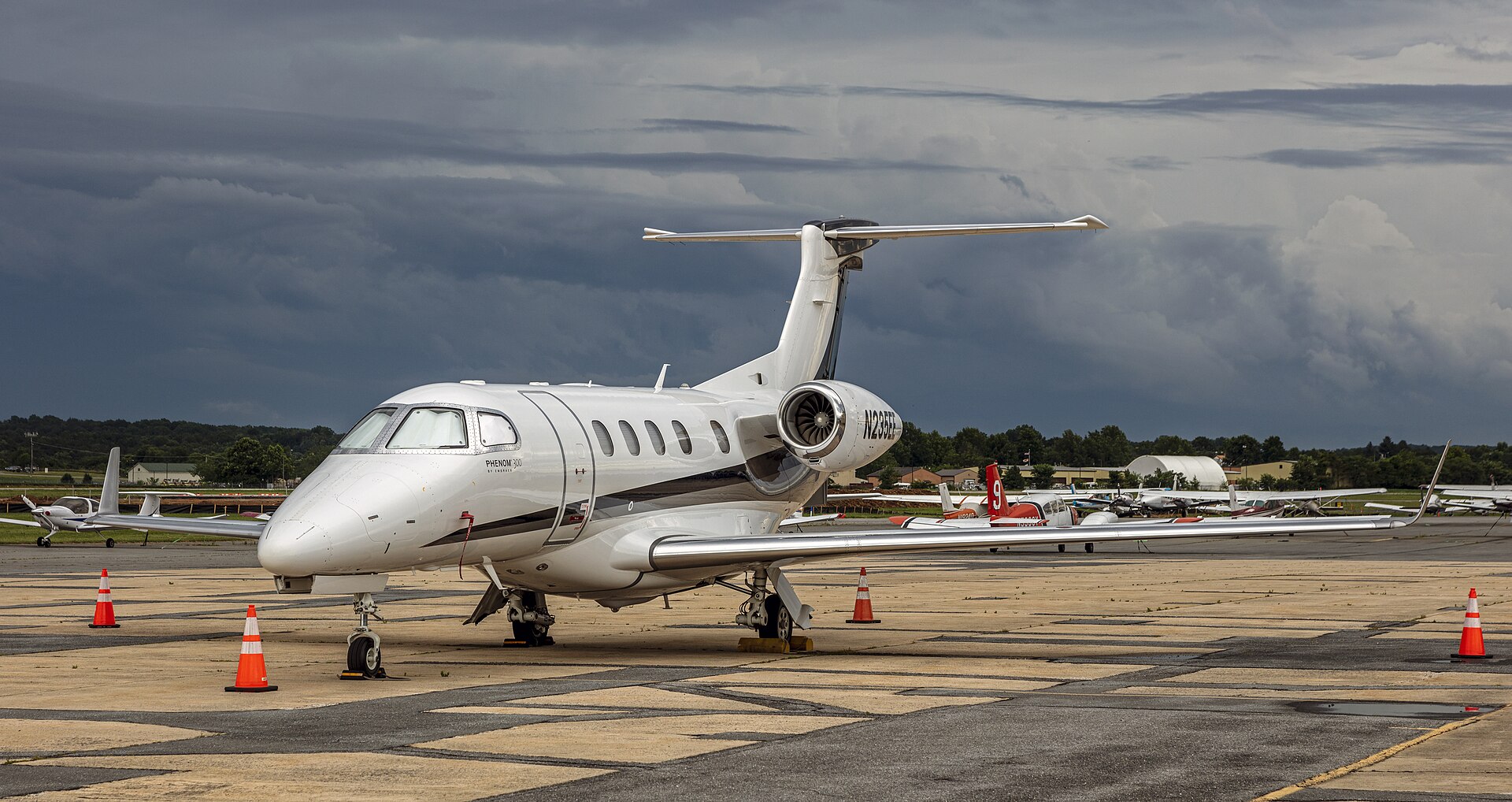
The light jet is the aircraft most private flyers actually use: two-hour legs, six people, a regional business trip or a weekend away. It is also the segment where the manufacturers disagree most about what the customer wants. Embraer built a small airliner. Textron Aviation built the definitive owner-flown business jet. Honda built an engineering statement. Pilatus built a jet that can land on gravel. All four sell well, and each is the right answer for a different buyer.
The numbers
| Embraer Phenom 300E | Cessna Citation CJ4 Gen2 | HondaJet Elite II | Pilatus PC-24 | |
|---|---|---|---|---|
| Passengers (typical / max) | 7 / 10 | 7 / 10 | 5 / 7 | 6 / 10 |
| Range, 4 passengers (nm) | 2,010 | 2,165 | 1,547 | 2,000 |
| High-speed cruise | Mach 0.80 (464 kt) | 451 kt | 422 kt | 440 kt |
| Cabin height / width | 4 ft 11 in / 5 ft 1 in | 4 ft 9 in / 4 ft 10 in | 4 ft 10 in / 5 ft 0 in | 5 ft 1 in / 5 ft 7 in |
| Cabin length | 17 ft 2 in | 17 ft 4 in | 12 ft 1 in | 23 ft 0 in |
| Baggage | 84 cu ft | 77 cu ft | 66 cu ft | 90 cu ft, with cargo door |
| Takeoff distance (MTOW) | 3,209 ft | 3,410 ft | 3,699 ft | 2,930 ft |
| Landing distance | 2,212 ft | 2,940 ft | 2,562 ft | 2,375 ft |
| Unpaved runway capable | No | No | No | Yes |
| Single-pilot certified | Yes | Yes | Yes | Yes |
| Engines | Pratt and Whitney PW535E1 | Williams FJ44-4A | GE Honda HF120 | Williams FJ44-4A-QPM |
| Fuel burn, typical cruise (gal/hr) | 180 | 185 | 120 | 175 |
| Typical equipped price (USD m) | 12.0 | 11.5 | 7.2 | 12.5 |
| Direct operating cost per hour (USD) | 2,100-2,400 | 2,000-2,300 | 1,500-1,800 | 2,000-2,300 |
| 2025 deliveries | over 60 | over 30 | approx. 20 | approx. 45 |
Embraer Phenom 300E
The Phenom 300 series has been the world's best-selling light jet for fourteen consecutive years, and the current 300E is the reason. It is the fastest of the four, the only one to cruise at Mach 0.80, and it has the most airliner-like cabin: a proper oval cross-section, a real lavatory with a window, a galley with an espresso option, and Embraer's Bossa Nova interior that would not look out of place in a Praetor. The Garmin G3000-based Prodigy Touch flight deck now includes runway overrun awareness and a predictive windshear system, unusual in the class. The Phenom's main weaknesses are a cabin that is loud by midsize standards and a purchase price at the top of the segment. Its resale is exceptionally strong because the fractional operators, particularly NetJets and Flexjet, both fly it in large numbers and absorb pre-owned examples.
Cessna Citation CJ4 Gen2
The CJ4 Gen2 is the culmination of thirty years of CitationJet evolution: a straightforward, reliable, well-supported aircraft that owner-pilots and small flight departments trust. It has the longest range of the four with four passengers, benefits from Textron's unmatched service network, and its Gen2 update brought a quieter, more refined cabin with better seats and lighting. Its Collins Pro Line 21 avionics are proven if less glamorous than Garmin's. The CJ4 gives away speed and cabin cross-section to the Phenom and looks dated beside it, but its operating costs are marginally lower, its dispatch reliability is outstanding, and it is the easiest of the four for a single pilot to manage on a busy day. Textron's ability to deliver a CJ4 sooner than Embraer can deliver a Phenom is a real advantage in 2026.
HondaJet Elite II
The HondaJet is the aircraft people ask about. Its over-the-wing engine mounts, natural laminar flow wing and carbon-composite fuselage make it the most fuel-efficient jet in the class by a wide margin, and its cabin, though shortest, is remarkably quiet because the engines are nowhere near it. The Elite II added range (now 1,547 nm), a higher maximum takeoff weight, ground spoilers, and autothrottle, with a full autoland system arriving under a separate certification. The trade-offs are a cabin for five in comfort rather than seven, less baggage, a less extensive service network than the big three, and a range that rules out many of the 1,800 to 2,000 nm missions the others fly nonstop. Honda has also announced the larger HondaJet Echelon, a light jet with transcontinental range, which has cooled some demand for the Elite II among buyers who can wait. For a two-hour mission profile with four passengers, however, nothing in the class is cheaper to fly or more pleasant inside.
Pilatus PC-24
The PC-24 is the outlier. Pilatus designed it to do what the PC-12 turboprop does, only faster: operate from short, unpaved and unimproved airstrips, carry bulky cargo through a proper cargo door, and reconfigure quickly between passenger, medevac and combi layouts. The 2024 update raised payload by more than 600 pounds and pushed range to 2,000 nm with four passengers. It has the widest and tallest cabin of the four, a flat floor, and an executive interior that is genuinely luxurious. The price is that it is the slowest of the jets at 440 knots, the most expensive to buy, and its unpaved-field capability is irrelevant to owners who only ever land on tarmac. But for a rancher, a mining executive, an island resort owner or anyone who needs to bring skis, bicycles or samples, the PC-24 is a category of one. Pilatus also has a distinctive customer base in Australia, Africa and the American West where its capabilities are used daily.
Operating economics
On a five-year hold at 350 hours a year, the four aircraft are closer in total cost than their prices suggest, because the Phenom's stronger residual value offsets its higher entry price and the HondaJet's lower fuel and maintenance costs offset its weaker resale. A rough estimate of total cost of ownership over five years including depreciation, at 350 hours:
| Phenom 300E | CJ4 Gen2 | HondaJet Elite II | PC-24 | |
|---|---|---|---|---|
| Purchase | 12.0 | 11.5 | 7.2 | 12.5 |
| Residual after 5 years | 8.5 | 7.8 | 4.5 | 8.6 |
| Depreciation | 3.5 | 3.7 | 2.7 | 3.9 |
| Operating (1,750 hours) | 4.9 | 4.6 | 3.4 | 4.7 |
| Fixed (crew, hangar, insurance) | 2.8 | 2.7 | 2.4 | 2.8 |
| Five-year total (USD m) | 11.2 | 11.0 | 8.5 | 11.4 |
The verdict
- Phenom 300E for buyers who want the fastest, most refined light jet with the strongest resale and do not mind waiting.
- Citation CJ4 Gen2 for owner-pilots and flight departments who value range, support and simplicity over glamour.
- HondaJet Elite II for missions under two and a half hours with four or five passengers, where its efficiency and quiet cabin are unmatched.
- PC-24 for owners who need a jet that goes where jets do not go, and who will actually use a cargo door.
The light jet market has never offered four such different aircraft at once. Choose the mission first and the aircraft will select itself.
Mentioned in this story
More insights

What luxury really means on a VIP airliner
A VIP airliner is not just a larger private jet. Its real luxury is measured in certified space, sleep, quiet systems, completion time, crew workflow and the ability to carry a household or delegation across oceans without turning the cabin into theatre.
Farnborough, Biggin Hill or Luton: choosing a London private jet airport
Compare the final ground destination, operating window, aircraft requirements and handling arrangements before choosing a London airport.
Teterboro, Westchester or Morristown: choosing a New York private jet airport
Compare the airport and ground destination together, then check handling, timing, noise requirements and a fallback before accepting a charter proposal.