Inside a $75 Million Gulfstream G700: Bedrooms, Showers, and the Longest Cabin in Its Class
Gulfstream's flagship is 57 feet of cabin split into up to five rooms, with a shower, a bed, a full galley, and the largest windows in business aviation. A room-by-room tour, with the numbers.
By JetAtlas · Published 2026-05-05 · 8 min read · How we check facts

The first thing a visitor notices about the Gulfstream G700 is not any individual feature. It is that walking from the front to the back takes long enough that you stop thinking of it as an aircraft cabin and start thinking of it as a corridor with rooms off it. At 56 feet 11 inches, the cabin is the longest in Gulfstream's line-up, and Gulfstream sells it on exactly that basis: not seats, but living areas.
Gulfstream launched the G700 in October 2019 at $75 million; the FAA certified it in March 2024, and by June 2026 the company had delivered its 100th aircraft. Published prices in 2026 sit around $78 million to $81 million depending on configuration. Here is what that buys, room by room, working from the nose back.
The numbers first
| Specification | G700 |
|---|---|
| Cabin length (excluding baggage) | 56 ft 11 in (17.35 m) |
| Cabin width | 8 ft 2 in (2.49 m) |
| Cabin height | 6 ft 3 in (1.91 m) |
| Windows | 20 panoramic ovals, each about 28 in wide |
| Living areas | Up to 5, or 4 plus a grand suite |
| Maximum passengers | 19 |
| Sleeping berths (typical) | Up to 13 |
| Range | 7,750 nm at Mach 0.85 (7,500 nm at Mach 0.90) |
| Maximum speed | Mach 0.935 |
| Ceiling | 51,000 ft |
| Cabin altitude at 41,000 ft | 2,840 ft |
| Engines | 2 x Rolls-Royce Pearl 700, 18,250 lb thrust each |
| Baggage hold | 195 cu ft, accessible in flight |
Cabin dimensions and performance are from Gulfstream's published specifications; layouts described below are typical configurations, not a single fixed floor plan.
The front: crew, galley, and the crew rest
Behind the cockpit sits a forward lavatory and a crew rest area, which on a 15-hour flight matters: the G700 can carry four pilots and a flight attendant, and the extra crew need somewhere to sleep that is not in the passengers' way. Buyers can specify a compact crew rest with a berthable seat, or a proper closed compartment.
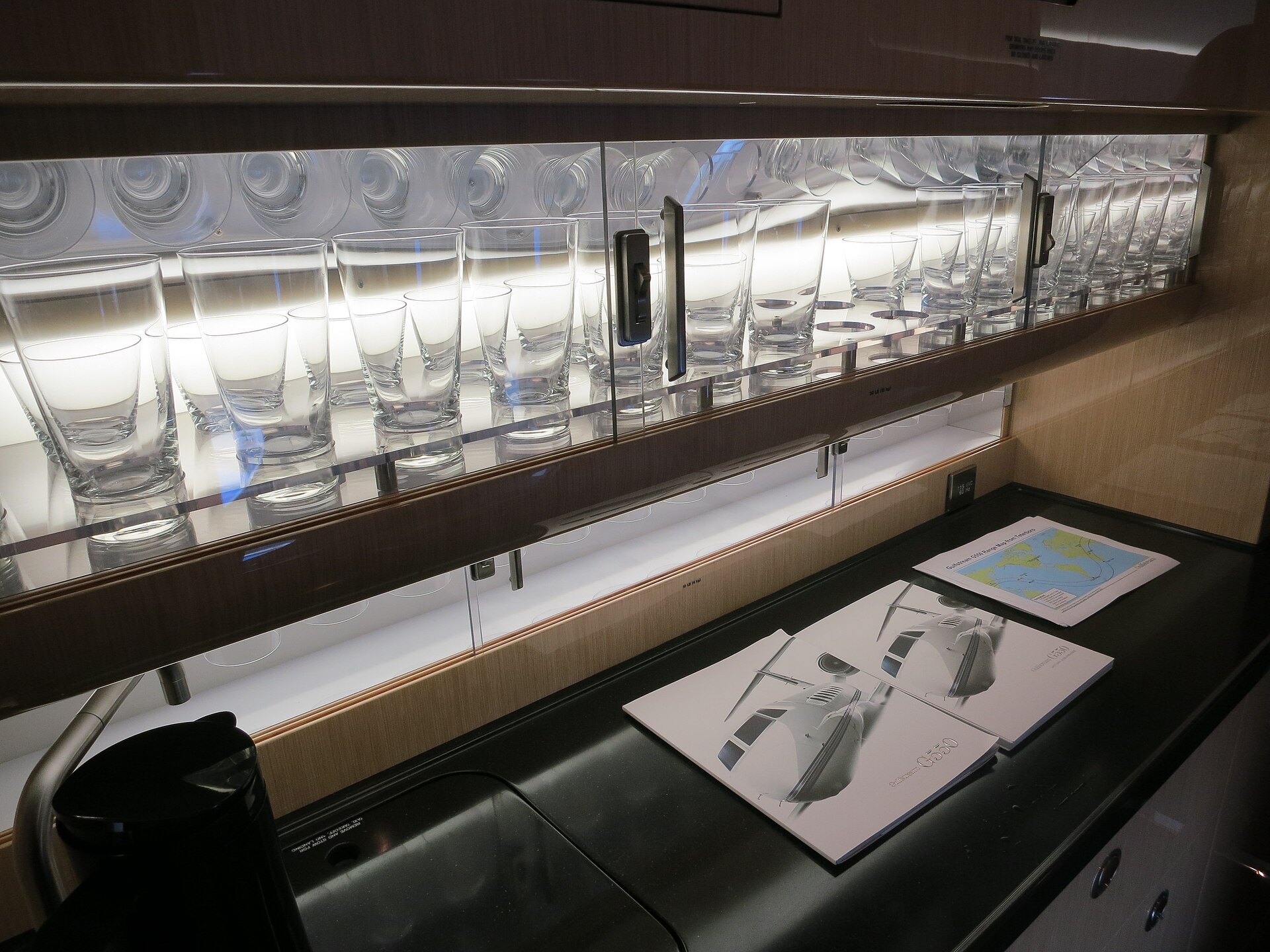
Then comes the galley, which is where the G700 stops resembling any other business jet. The largest option, which Gulfstream calls the ultragalley, is more than 10 feet long, with a full-height refrigerator, convection and steam ovens, an induction cooktop option, a sink with a real tap, stone or composite counters, and enough storage for a multi-course dinner for a dozen people. Corporate buyers tend to specify something smaller; private owners and heads of state go for the ultragalley and hire a chef who is also the flight attendant.
Living area one: the lounge
The first passenger zone is usually a club of four single seats, two facing forward and two aft, each of which reclines flat and has its own window (in fact, a pair of windows: 20 ovals along a 57-foot cabin means a window every couple of feet). Gulfstream's seats are its own design, hand-stitched in its Savannah plant, and buyers choose leathers and stitching from a bespoke library or bring their own.
The lighting here is the G700's quiet party trick. It is fully circadian: the crew or the passengers programme it to shift colour temperature to match the destination time zone, so a flight from New York to Tokyo dims towards a warm sunset in the evening hours of Japan, not New York. Gulfstream's cabin management app runs from an iPhone, and every seat has a touch panel for lighting, shades, and temperature.
Living area two: dining and conference
The second zone is almost always a six-place dining table, four across on one side and a two-seat divan opposite, or a four-place conference grouping. The table is a proper table: you can seat six adults for dinner with plates, glasses, and elbow room. This zone doubles as the boardroom on a corporate aircraft, with a large monitor on the forward bulkhead and Ka-band satellite connectivity fast enough for video calls.
Living area three: the entertainment lounge
Behind the dining area, a divan (which converts to a bed) faces a pair of seats and a large screen. On many aircraft this is the family zone, with the divan doubling as a children's bunk. A partition with a pocket door separates it from what comes next, and sound insulation between zones is a design priority; Gulfstream quotes cabin noise in the high forties of decibels, which is quieter than most offices.
Living area four: the grand suite
At the back, roughly 15 to 18 feet of the cabin can be closed off as a private bedroom. A fixed queen-size bed sits against one wall, with a wardrobe, a small desk or vanity, and a dedicated entertainment system. This is the configuration that private owners overwhelmingly choose; a corporate flight department is more likely to make zone four a second lounge with a berthable divan.
Behind the bedroom is the aft lavatory, and here is where the G700 competes with the widebody VIP airliners: a shower. The stall is compact, with a heated floor and roughly 10 minutes of water at a comfortable pressure from a dedicated tank. On a 14-hour flight from Los Angeles to Sydney, stepping out of a hot shower an hour before landing is the single feature owners mention most.
The baggage hold behind the lavatory is accessible in flight, which sounds minor until you need a different suitcase on hour nine.
The materials and the weight problem
Everything in the cabin has to be certified for flammability, crash loads, and weight. The last constraint is the one that drives design. Stone counters are real stone, but sliced to two or three millimetres and bonded to a honeycomb core. Wood veneers are a fraction of a millimetre thick over composite panels. A cabin that looks like a hotel suite weighs a fraction of what the same suite would weigh in a hotel, and every kilogram the interior adds is a kilogram of fuel or range given up.
A few of the weight-saving tricks that a visitor never notices:
- Seat frames are machined aluminium and carbon fibre; the leather is the heaviest part
- Cabinetry is honeycomb-cored composite with veneer skins, hollow inside
- Window shades are electrically dimmable glass rather than mechanical blinds
- The shower's water supply is metered to a fixed tank, so the aircraft never carries more water than a single shower needs
Completion of a G700 interior, from a green aircraft to delivery, takes months at Gulfstream's own completion centres in Savannah, Georgia, and Appleton, Wisconsin. Unlike the VIP airliner world, Gulfstream does its own interiors, which is one reason its delivery schedules are more predictable and its price tags include the cabin.
The engineering underneath
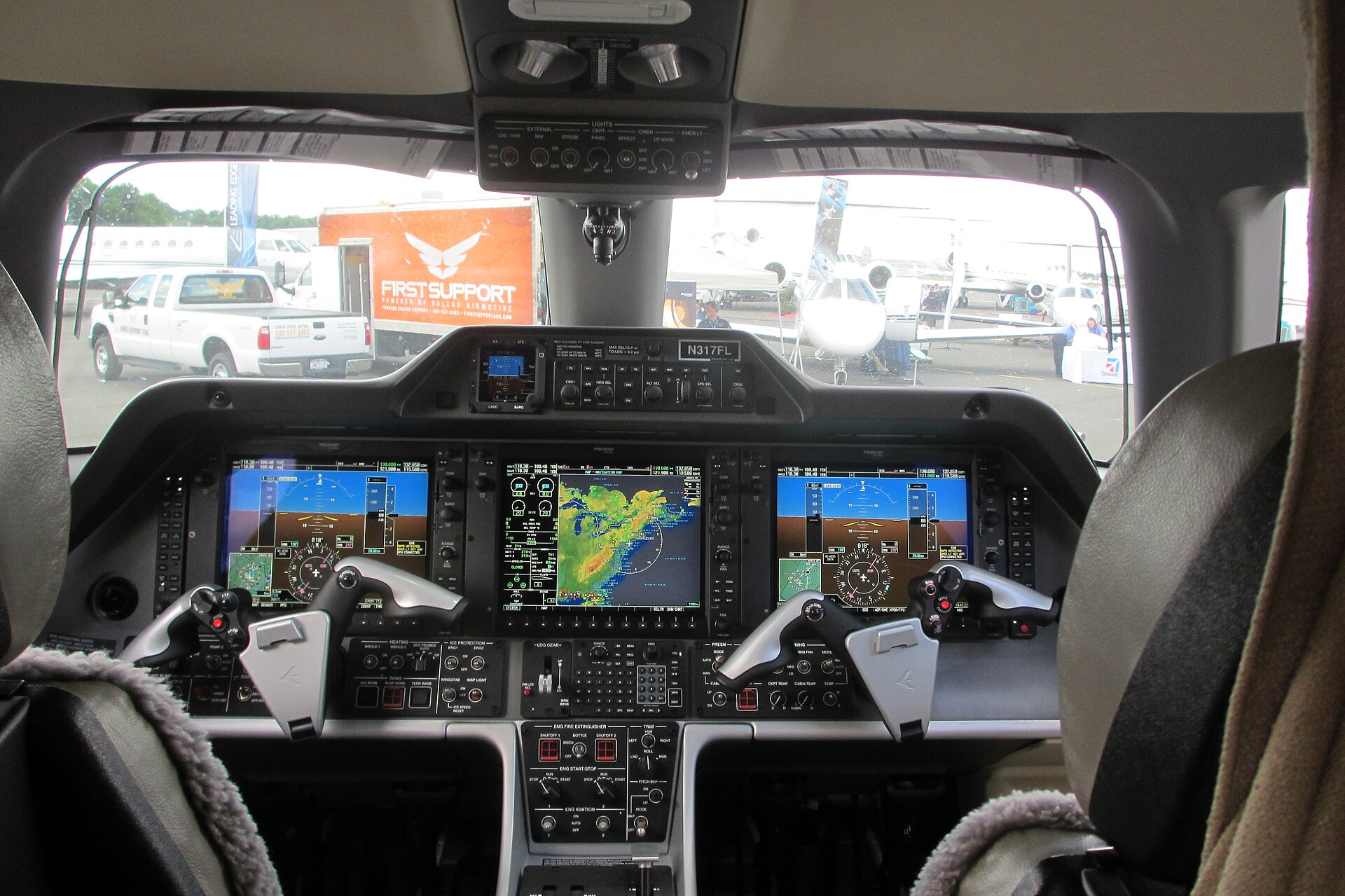
None of the above works without the pressurisation and air system. The G700 holds a cabin altitude of 2,840 feet when cruising at 41,000 feet, and 100 percent fresh air is replenished every two to three minutes, with no recirculation. The Rolls-Royce Pearl 700 engines were designed for the aircraft, and the flight deck is Gulfstream's Symmetry system with active side-sticks: the two sticks move together, so each pilot can feel what the other is doing.
Who buys one
Gulfstream does not publish customer names, but the G700's backlog is a mix of Fortune 500 flight departments (which specify the four-zone layout and skip the shower), fractional operator Flexjet (which ordered dozens), private owners in the U.S., the Gulf, and Asia, and government VIP fleets. At $79 million plus roughly $3 million to $5 million a year to operate, it is not a rational purchase for anyone, and it is not meant to be. It is meant to make a 16-hour flight feel like a night in a good hotel, and by most accounts it does.
Mentioned in this story
More insights

What luxury really means on a VIP airliner
A VIP airliner is not just a larger private jet. Its real luxury is measured in certified space, sleep, quiet systems, completion time, crew workflow and the ability to carry a household or delegation across oceans without turning the cabin into theatre.
Farnborough, Biggin Hill or Luton: choosing a London private jet airport
Compare the final ground destination, operating window, aircraft requirements and handling arrangements before choosing a London airport.
Teterboro, Westchester or Morristown: choosing a New York private jet airport
Compare the airport and ground destination together, then check handling, timing, noise requirements and a fallback before accepting a charter proposal.