Sleeping on a Private Jet: Real Beds, Thinner Air and the Pilots Who Take Turns
Most private jets make beds out of seats. The largest now have fixed bedrooms, cabins pressurised below 3,000 feet and lights that imitate sunrise. What actually helps passengers sleep, and where the pilots rest on a 15-hour flight.
By JetAtlas Editors · Published 2026-09-12 · 5 min read · How we check facts
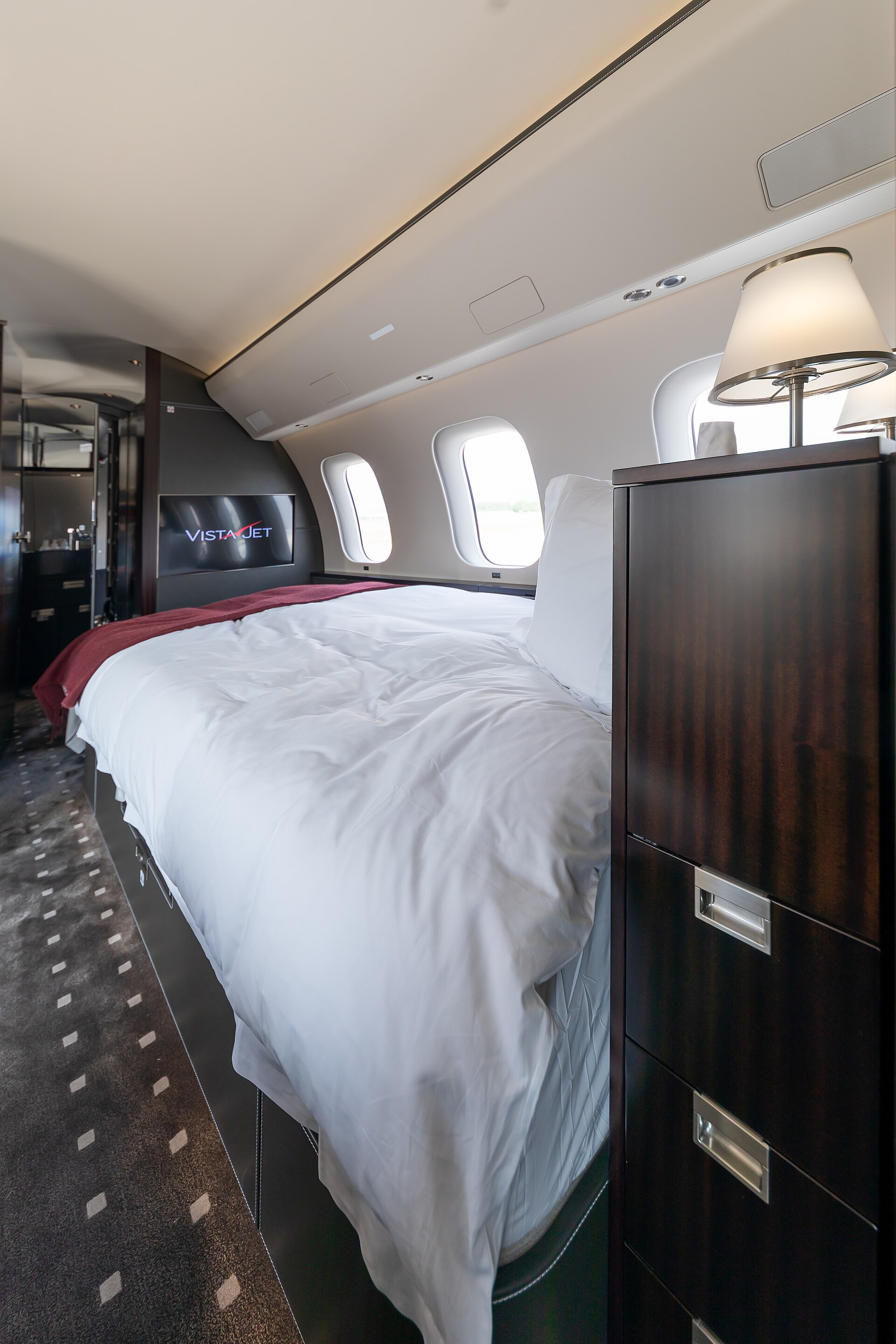
The rearmost room of a Bombardier Global 8000 is marketed as the principal suite: a full-size bed with a customisable headboard, an en-suite lavatory and an optional stand-up shower. At 41,000 feet the air in that room is pressurised to the equivalent of 2,691 feet. A passenger asleep over the Pacific is breathing air closer to that of a hill town than of the mountain resort an airliner cabin imitates.
That combination, a real bed plus low cabin altitude, separates the newest ultra-long-range jets from almost everything else in the sky. On most private aircraft, sleep is still improvised.
Three ways to lie down
Beds on business jets come in three forms, and the difference matters.
- Berthable seats. Two facing club seats that slide and recline until their cushions meet to form a flat surface. They are common on midsize and large jets; the Dassault Falcon 10X offers them in an optional privacy suite.
- Divans. A sofa along one side of the cabin that converts into a bed, usually made up by the cabin attendant with a mattress topper and linen. The entertainment suite of the Global 7500 has a berthable divan.
- Fixed beds. A permanent bed in a separate stateroom with a door. The Global 7500 and 8000, the Gulfstream G700 and the Falcon 10X, which Dassault says can take a true queen-size bed, all offer this layout.
Whatever the bed, every passenger still needs a certified seat with a belt for take-off and landing. The bed is for cruise only, which is why staterooms also contain a proper seat or a certified divan.
Capacity drops when people lie down. Gulfstream says the G700 seats up to 19 passengers but sleeps up to 13, depending on the layout.
The air you sleep in
Cabin altitude is the height at which the cabin's air pressure would be found on the ground. Airliners have traditionally been pressurised to between 6,000 and 8,000 feet; the Boeing 787 and Airbus A350 manage about 6,000. A lower cabin altitude puts more oxygen into the blood, and passengers generally report less headache and grogginess on arrival.
| Aircraft | Cabin altitude | At cruise altitude of | Where to sleep |
|---|---|---|---|
| Older airliner | up to 8,000 ft | airliner cruise | seats or flat-bed seats |
| Boeing 787 / Airbus A350 | about 6,000 ft | airliner cruise | seats or flat-bed seats |
| Dassault Falcon 8X | 6,000 ft | 51,000 ft | divans; crew rest with a 78-inch bed in long-cabin layout |
| Gulfstream G700 | 2,840 ft | 41,000 ft | sleeps up to 13; fixed-bed suite option |
| Bombardier Global 8000 | 2,691 ft | 41,000 ft | full-size bed in the principal suite |
Humidity is the other half of the story. Outside air at cruise altitude is almost completely dry, and without a humidifier the air in a large business jet can sit below 5 percent relative humidity, according to CTT Systems, a Swedish maker of cabin humidifiers. Its systems raise that to between 20 and 23 percent. They are fitted to Airbus ACJ320s, CTT was selected in 2022 to develop one for the ACJ TwoTwenty, and it is adapting its system to the Global 7500. Business Jet Traveler once described galley crews working in humidity as low as 2 percent.
Air quality is the third factor. Gulfstream says the G700 replaces its cabin air with 100 percent fresh, plasma-ionised air every two to three minutes.
Light as a sleeping aid
Jet lag is a clock problem rather than an air problem: the body's circadian rhythm falls out of step with local daylight. Manufacturers now try to nudge that clock with light.
Bombardier's Soleil lighting, fitted throughout the Global 7500 and 8000, is linked to the flight management system and simulates dawn, day, dusk and night along the route, a feature Bombardier calls Dynamic Daylight Simulation. The G700 uses a circadian system developed with Heads Up Technologies, whose partnership with Gulfstream was announced in March 2021: a dense array of LEDs with precise colour control that can stage a sunrise before landing.
Whether any of this shortens jet lag has not been established by independent research. Lower cabin altitude, fresher air and a flat bed clearly reduce travel fatigue, and that can make jet lag feel milder. JetAtlas rates the claim "plausible" in Hangar talk.
Who flies while everyone sleeps
Long flights raise a problem for the crew. Under U.S. charter rules, 14 CFR 135.267, a two-pilot crew on unscheduled flights may log no more than 10 hours of flight time in 24 consecutive hours. A 14-hour trip therefore needs a third or fourth pilot.
Under 14 CFR 135.269, a three-pilot crew may be aloft for up to 12 hours and a four-pilot crew up to 16. No pilot may spend more than 8 hours on flight-deck duty in 24 hours, and the operator must provide adequate sleeping facilities on the aircraft for the relief pilot.
So ultra-long-range jets are built with somewhere for pilots to lie down:
- The Global 7500's crew suite can be fitted with bunk beds.
- The Global 8000 has a private crew suite with a Nuage seat, power outlets and storage.
- On the Falcon 8X, a crew rest area with a 78-inch bed is available in the long-cabin layout.
- Dassault designed the Falcon 10X flight deck so the pilot seats themselves recline fully flat, for missions of more than 15 hours.
The one thing nobody on board can sleep through is the landing. Shortly before descent, the attendant wakes the passengers and clears away the linen, and the certified seat in the stateroom, ignored for most of the night, finally does its job.
Sources
More insights
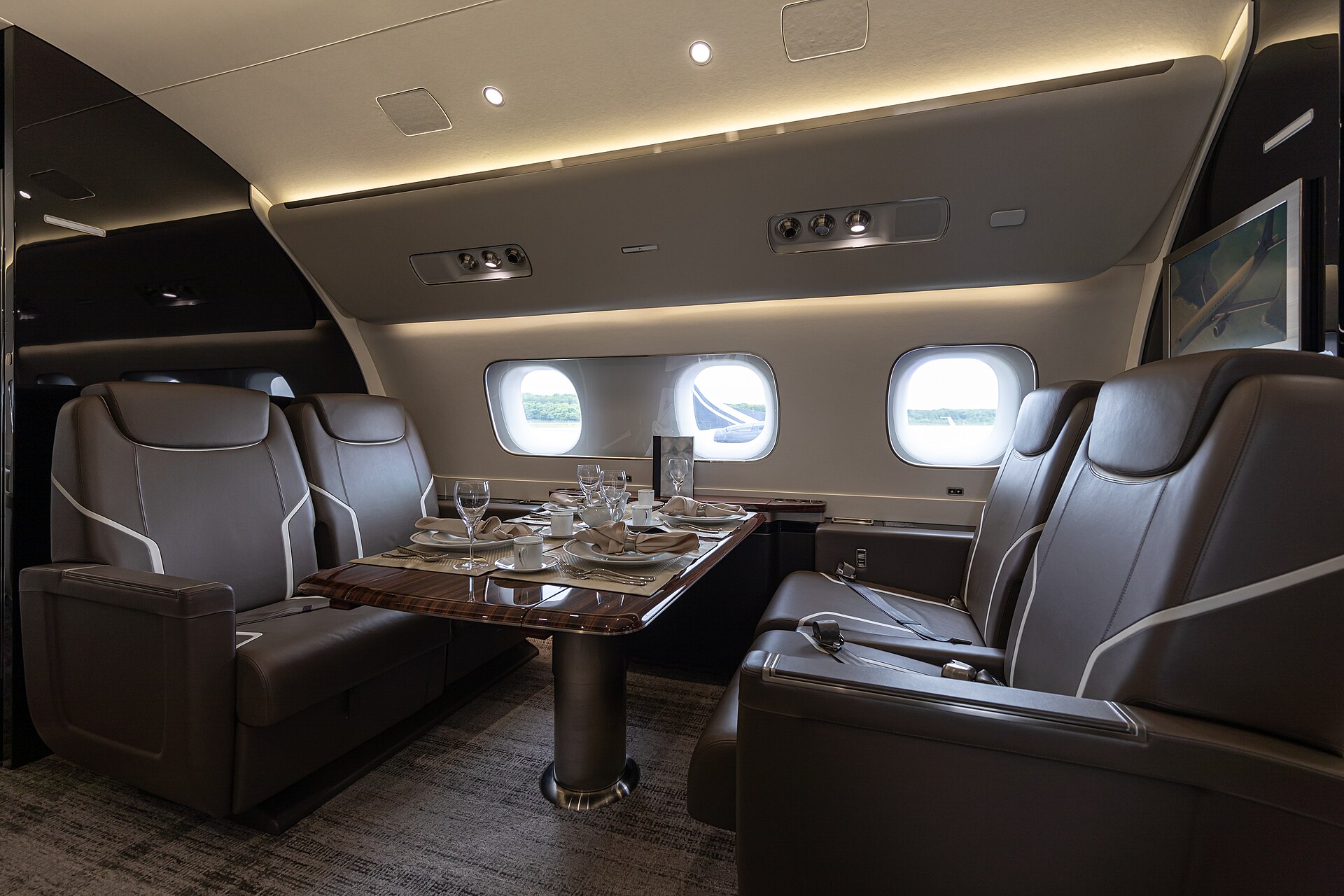
Food at 45,000 Feet: How Private-Jet Catering Actually Works
Almost nobody cooks on a private jet. Meals are made on the ground, chilled, delivered about 90 minutes before departure and finished in a galley the size of a wardrobe. Who does the work, why food tastes different up there, and how one sandwich reached $177.
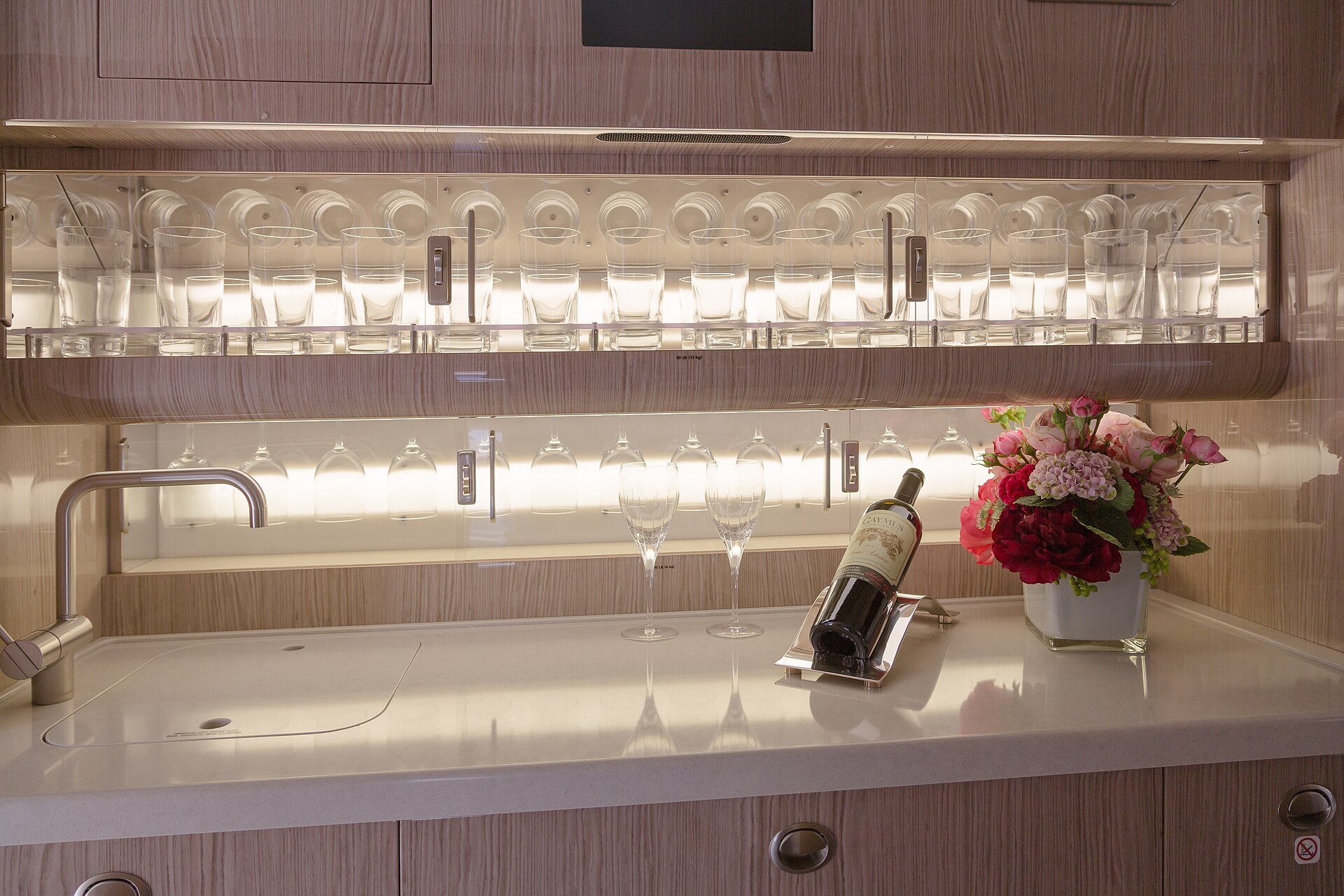
Drinks on Board: Wine, Champagne, Coffee and Water at Cabin Altitude
A pressurised cabin dulls sweetness, strips the fruit from light wines, flattens champagne faster and makes water boil below 100°C. What that means for the bar on a private jet, and the strict alcohol rules that apply to the crew.
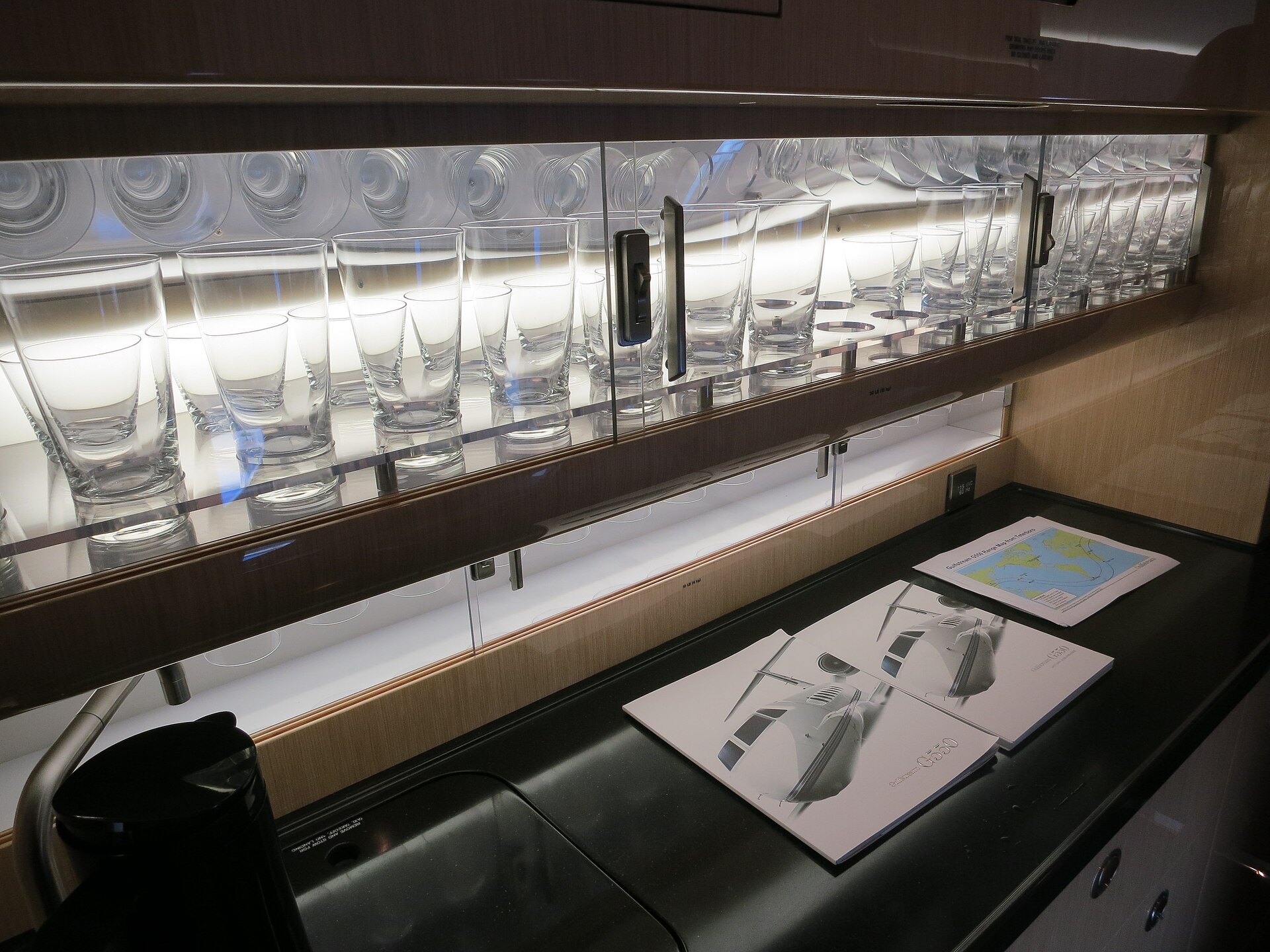
The Galley: How a Private-Jet Kitchen Fits in a Cupboard
A business-jet galley has to fit a refrigerator, ovens and a coffee machine into the space of a wardrobe, survive crash loads and run on aircraft power. What is inside, what it weighs, and what a flight attendant can really cook.