The Galley: How a Private-Jet Kitchen Fits in a Cupboard
A business-jet galley has to fit a refrigerator, ovens and a coffee machine into the space of a wardrobe, survive crash loads and run on aircraft power. What is inside, what it weighs, and what a flight attendant can really cook.
By JetAtlas · Published 2026-09-12 · 5 min read · How we check facts
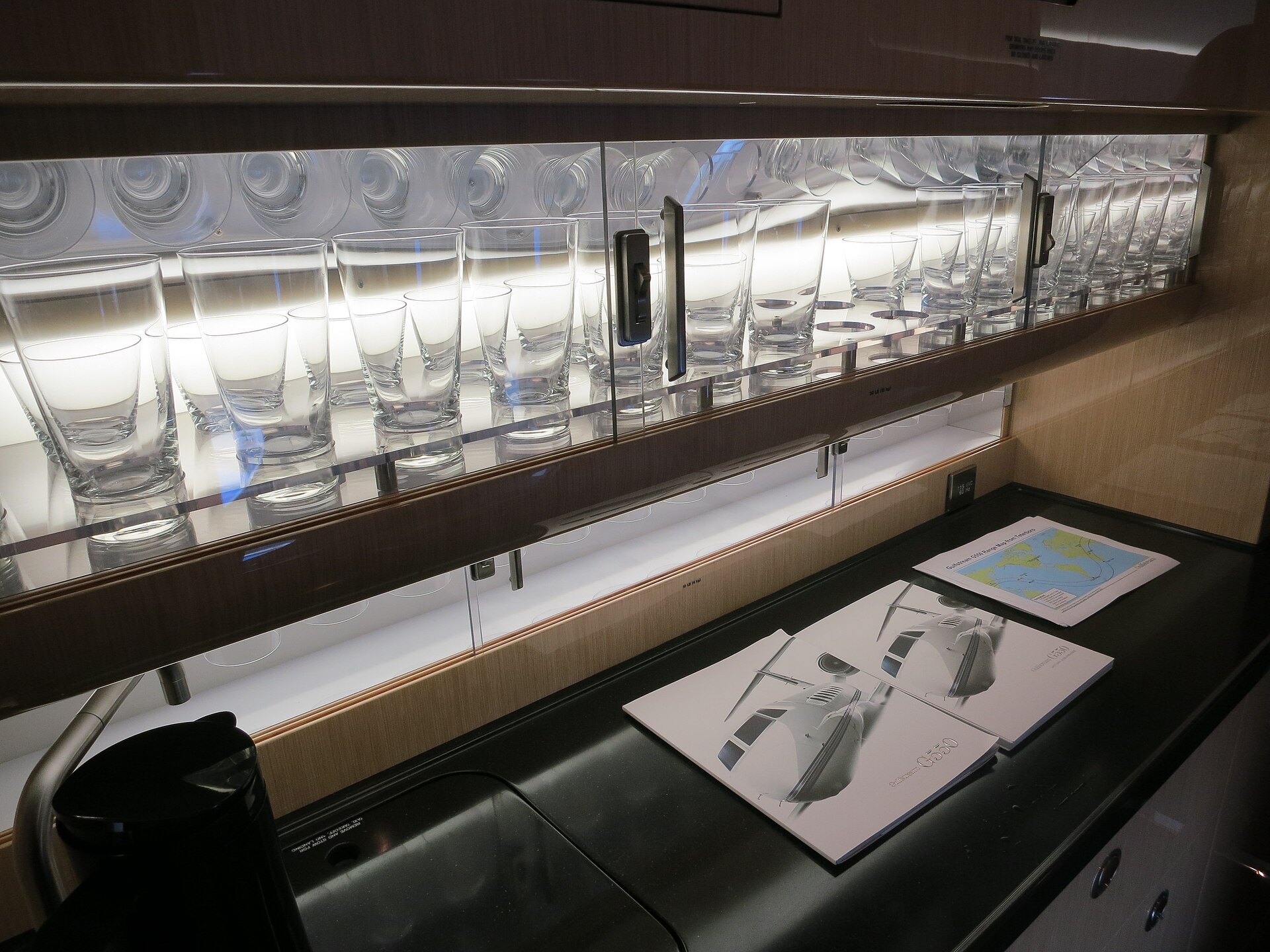
A refrigerator made for business-jet galleys by the American supplier Enflite weighs 19 kg, keeps food between 0°C and 6.7°C, and is rated to carry 40 lb of contents when mounted facing sideways or aft, but only 20 lb when it faces forward. The difference is physics. In a sudden stop, everything in a forward-facing fridge tries to leave through the door. Galley equipment has to meet the emergency-landing load factors in the U.S. certification rules, 14 CFR 25.561, and the fridge door latch is part of that calculation.
That one specification sums up the private-jet kitchen. It is a real kitchen, sometimes a very good one, built to survive a crash and designed around limits of weight, power and space that a home cook would find absurd.
What is inside
A galley on a large-cabin jet combines some or all of the following:
- Ovens. Convection ovens for reheating and crisping, microwaves for speed and, on some aircraft, steam ovens that stop food drying out. Bombardier's Global 8000 has dual convection-microwave ovens.
- Cold storage. A chiller or refrigerator, plus insulated ice drawers with drains. Many smaller jets have only ice. The Swiss firm Bucher makes an insulated galley box that keeps food and drinks cold without a chiller or dry ice.
- Warming and cooling drawers. Enflite's version holds up to 22.7 kg and runs anywhere between 4°C and 60°C.
- Hot drinks. A coffee maker and, as an option, an espresso machine. Iacobucci HF Aerospace in Italy builds both, along with induction ovens.
- Water. A sink and faucet fed from the aircraft's potable-water tank.
- Storage. Latched drawers and lockers for china, crystal, linen and cutlery.
Weight, power and space
Every appliance is a trade-off. Each kilogram in the galley is a kilogram less for fuel, passengers or bags, which is why suppliers publish weights to the decimal point.
| Galley item (Enflite range) | Weight | Capacity or range |
|---|---|---|
| Coffee maker, no plumbing needed | 7.3 kg (16 lb) | 1.5 litres of coffee |
| Refrigerator/freezer | 19 kg (42 lb) | 0°C to 6.7°C; 20 lb forward-facing, 40 lb side or aft-facing |
| Warming/cooling drawer | 10.4 kg (23 lb) | 22.7 kg (50 lb); 4°C to 60°C |
Power is the second ceiling. Galley appliances run on the aircraft's electrical system, and Enflite offers its units for either 28-volt DC or 115-volt AC supplies. The galley shares that power with everything else on board. A 2008 Business Jet Traveler survey found galleys with no electrical outlet at all and others with a single one, forcing the attendant to choose between the coffee pot and every other appliance. The same report said that working in a typical galley was like working in a closet, only with less room.
Space varies enormously. On the smallest jets, the galley may be a cabinet with an ice drawer and thermos flasks; hot food, if any, is warmed on the ground. At the other extreme, Bombardier describes the Global 8000's galley as the largest in the industry, with dual ovens, a sink and faucet and chilled storage. Gulfstream offers the G700 with a "Forward Ultragalley" next to a dedicated crew compartment. Business Jet Traveler described an earlier Global Express galley with a large warming oven, a convection oven, three insulated ice containers, pull-out counters and four electrical outlets.
What a flight attendant can actually prepare
The short answer: far more than reheating, and far less than a restaurant.
The standard method is to finish rather than cook. Caterers partly prepare dishes on the ground and chill them, and the attendant reheats, crisps, dresses and plates. That suits both the equipment and the food-safety rules. In 2014 Daniel Hulme, chief executive of the British caterer On Air Dining, told Corporate Jet Investor that cooked food should be blast-chilled below 8°C and kept out of the bacterial danger zone, between 8°C and roughly 70°C, for no longer than 90 minutes.
| Travels well | Travels badly |
|---|---|
| Charcuterie | Grilled steak |
| Salads and grain bowls | Fried food |
| Sandwich trays | Delicate shellfish |
Soufflés are a lost cause: Business Jet Traveler noted that they simply will not rise at cabin altitude.
Some corporate flight attendants are trained cooks. Business Jet Traveler profiled Joe Botelho, who trained in Italy and spent more than a decade as a flight attendant and chef with a Florida flight department, and reported that owners increasingly want attendants with culinary skills. The Corporate School of Etiquette, run by Donna Casacchia, employed a chef to teach two-day cooking courses for flight attendants.
Altitude sets its own limits. With cabins pressurised to as high as 8,000 feet on older aircraft and humidity as low as 2 percent, water boils at a lower temperature, so boiled and braised dishes take longer to cook. Nobody cooks over an open flame; heat comes from electric ovens and, on some aircraft, induction.
The largest galleys
On VIP airliners the galley stops being a cupboard. Air Force One, the U.S. Air Force VC-25A, has two galleys that can feed up to 100 people at a sitting. The Boeing Business Jet that VIP Completions refurbished in 2024 has a large mid-cabin galley with a bar alongside the main lounge. Converted airliners like these can carry commercial-grade equipment and the crew to run it.
Even the best business-jet galley has one constraint no supplier can design away. Before landing, every oven, drawer and locker has to be latched shut, down to the last box of teaspoons.
Sources
Mentioned in this story
More insights

What luxury really means on a VIP airliner
A VIP airliner is not just a larger private jet. Its real luxury is measured in certified space, sleep, quiet systems, completion time, crew workflow and the ability to carry a household or delegation across oceans without turning the cabin into theatre.
Farnborough, Biggin Hill or Luton: choosing a London private jet airport
Compare the final ground destination, operating window, aircraft requirements and handling arrangements before choosing a London airport.
Teterboro, Westchester or Morristown: choosing a New York private jet airport
Compare the airport and ground destination together, then check handling, timing, noise requirements and a fallback before accepting a charter proposal.