Bathrooms and Showers in the Sky: From the Belted Seat to the Stand-up Shower
On the smallest jets the toilet hides under a seat cushion. On the largest there is a stand-up shower with its own water tank. How private-jet lavatories work, what they cost, and why a shower is still rare even on the most expensive aircraft.
By JetAtlas Editors · Published 2026-09-12 · 5 min read · How we check facts
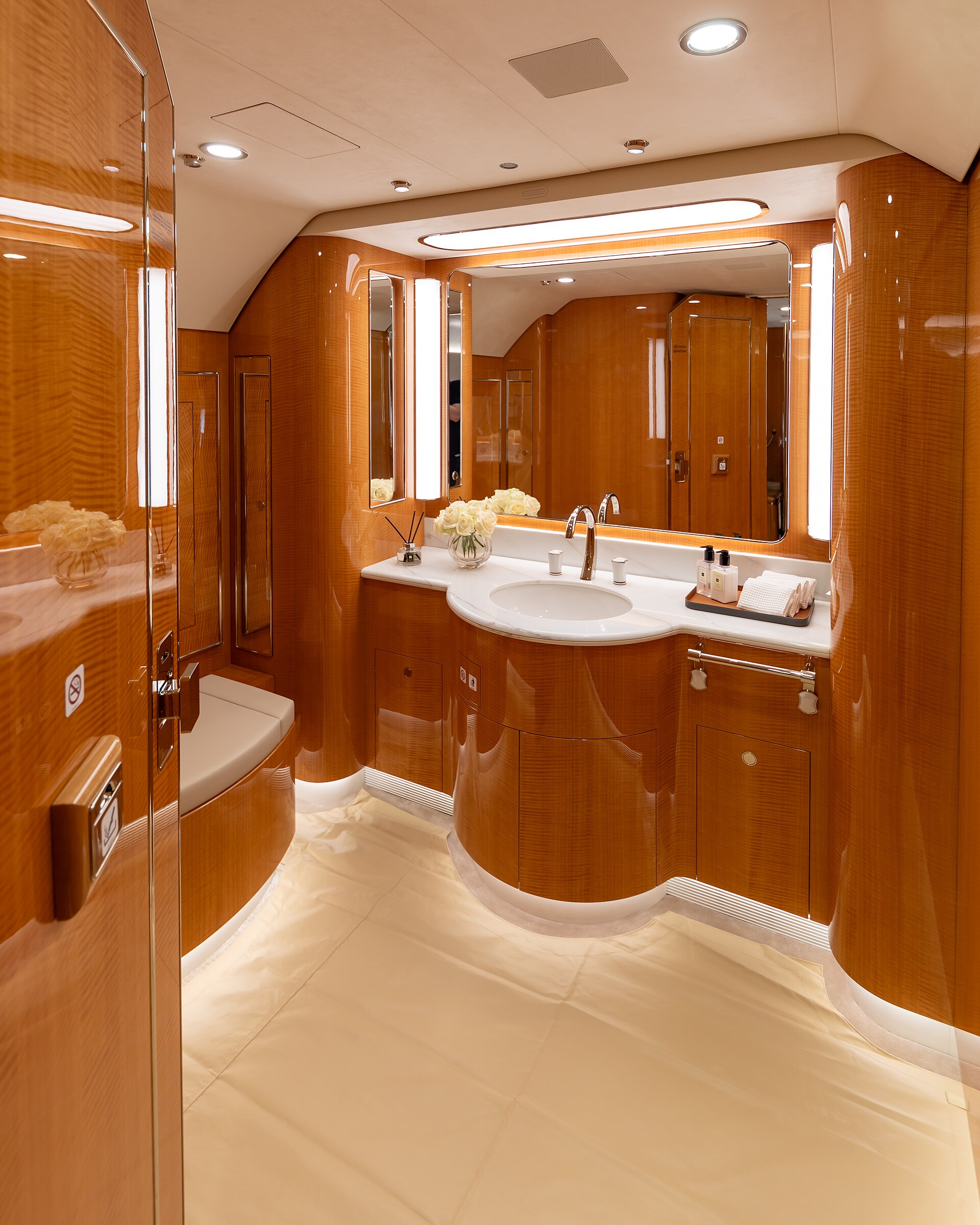
The shower option on a Dassault Falcon 8X draws from an 88-litre water tank, which Simple Flying reports gives about 30 minutes of running water. That is 30 minutes for everyone on board, for the entire flight. It is also 88 kilograms of water, about the weight of an adult passenger, that the aircraft carries whether anyone showers or not.
That trade-off explains most of what there is to know about bathrooms on private jets. Every toilet, basin and shower is a negotiation between comfort, water, weight and money.
Four kinds of lavatory
- The belted seat. On very light jets, the toilet hides beneath a passenger seat. The seat is certified with a belt so someone can sit on it for take-off and landing; lift the cushion and there is a chemical toilet underneath. A curtain or folding panel provides privacy. Air Charter Advisors lists the Citation Mustang, Phenom 100 and CitationJet among the aircraft with this kind of semi-enclosed lavatory.
- The chemical toilet. A container of deodorising solution with no flush, emptied by line staff at the FBO between flights. Business Jet Traveler described its crudest ancestor, a basin under a seat that was emptied by hand, as the honey bucket.
- Recirculating flush. Common on small and midsize jets. Blue-tinted water with sanitising agents is filtered and reused for each flush, which saves weight. The usual complaint is odour on long flights.
- Vacuum flush. The airliner system. A valve opens to a sealed waste tank and the flush is over in less than three seconds, using much less water than a recirculating toilet. James Kemper patented the vacuum toilet in 1975, and Boeing first installed one on an aircraft in 1982. On business jets it is found on large cabins such as the Global series and the Gulfstreams; the G700 has vacuum lavatories at both ends of the cabin.
From midsize jets upward, the lavatory is normally a fully enclosed compartment with a door and a sink, much like an airliner's, according to the Geneva-based broker LunaJets. Some add hands-free taps and a touchless flush.
| Lavatory type | Typical aircraft | Cost reported by BJT (2008) |
|---|---|---|
| Chemical toilet under a belted seat | Very light jets | Not stated |
| Recirculating blue-water flush | Small and midsize jets | About $15,000 plus installation |
| Vacuum flush | Large-cabin jets | From $25,000 plus installation |
| External servicing system for a vacuum toilet | Large-cabin jets | About $175,000 |
The job nobody photographs
Chemical and recirculating toilets are emptied on the ground by FBO line staff. Vacuum systems on large aircraft are serviced from outside the fuselage, so nobody has to carry a waste tank through the cabin. That external servicing system is the expensive part: about $175,000, according to Business Jet Traveler, several times the price of the toilet itself. The California lavatory maker Monogram Systems has said its technology can cut the water used by vacuum toilets by up to 50 percent, a useful saving when every litre is weight.
Which jets have showers
Showers are found on a short list of the largest business jets, always as an option and usually in the aft suite:
| Aircraft | Where the shower is | What is published |
|---|---|---|
| Dassault Falcon 8X | Aft lavatory, optional | 88-litre tank, about 30 minutes of water |
| Dassault Falcon 10X | Master suite, optional | Private stand-up shower |
| Gulfstream G700 | Grand suite, optional | Shower in the aft suite; vacuum lavatories fore and aft |
| Bombardier Global 7500 | Aft suite, optional | Shower in the en-suite lavatory |
| Bombardier Global 8000 | Principal suite, optional | Stand-up shower |
| Boeing Business Jet (VIP Completions, 2024) | Master stateroom | Full shower; three lavatories in total |
On converted airliners, a shower is less of a stretch because there is room for a real bathroom and larger tanks. The Boeing Business Jet that VIP Completions unveiled in February 2024 has three lavatories: one for the crew, a large VIP lavatory in mid-cabin and a master bathroom with a full shower. The presidential suite on Air Force One, a VC-25A, also includes a lavatory and a shower.
Why showers stay rare
- Weight. Water weighs a kilogram per litre, before counting the tank, heater, pump and drain. On a business jet that weight comes straight out of range or payload.
- Space. A shower cubicle takes floor area that could hold seats or a divan, and most buyers, especially charter and fractional operators, want the seats.
- Certification. Everything that stores, heats and drains water has to be certified for flight, including how it behaves in turbulence and where the waste water goes.
- Use. A shower matters on a 14-hour flight. On a two-hour hop it is dead weight.
Bathtubs are rarer still. The most famous ever announced, described by Business Jet Traveler in 2008 as what was believed to be the first Jacuzzi certified for in-flight use, belonged to the VIP interior planned for Prince Alwaleed bin Talal's Airbus A380. The aircraft never received that interior. JetAtlas confirms in Hangar talk that some jets really do have showers; the flying bathtub is another matter.
Divide the Falcon 8X's 30 minutes of water among a full cabin on a long night flight, and the most exclusive shower in business aviation works out at a few minutes each.
Sources
- Business Jet Traveler: the little cabin behind the cabin
- LunaJets: everything you need to know about private jet bathrooms
- Air Charter Advisors: do private jets have bathrooms?
- Simple Flying: Dassault Falcon 8X long-range features
- Gulfstream: G700
- VIP Completions: comprehensive Boeing Business Jet refurbishment
More insights
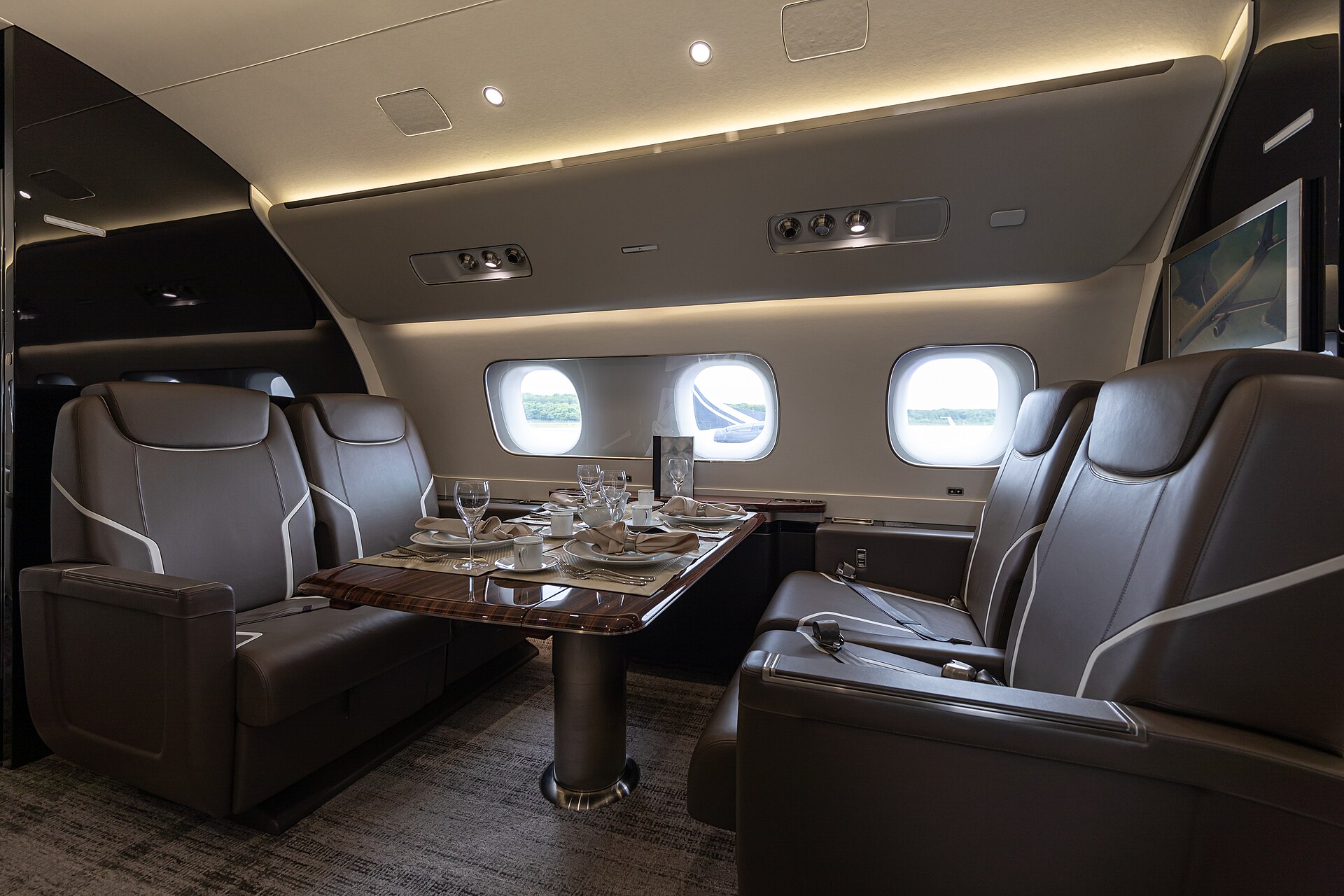
Food at 45,000 Feet: How Private-Jet Catering Actually Works
Almost nobody cooks on a private jet. Meals are made on the ground, chilled, delivered about 90 minutes before departure and finished in a galley the size of a wardrobe. Who does the work, why food tastes different up there, and how one sandwich reached $177.
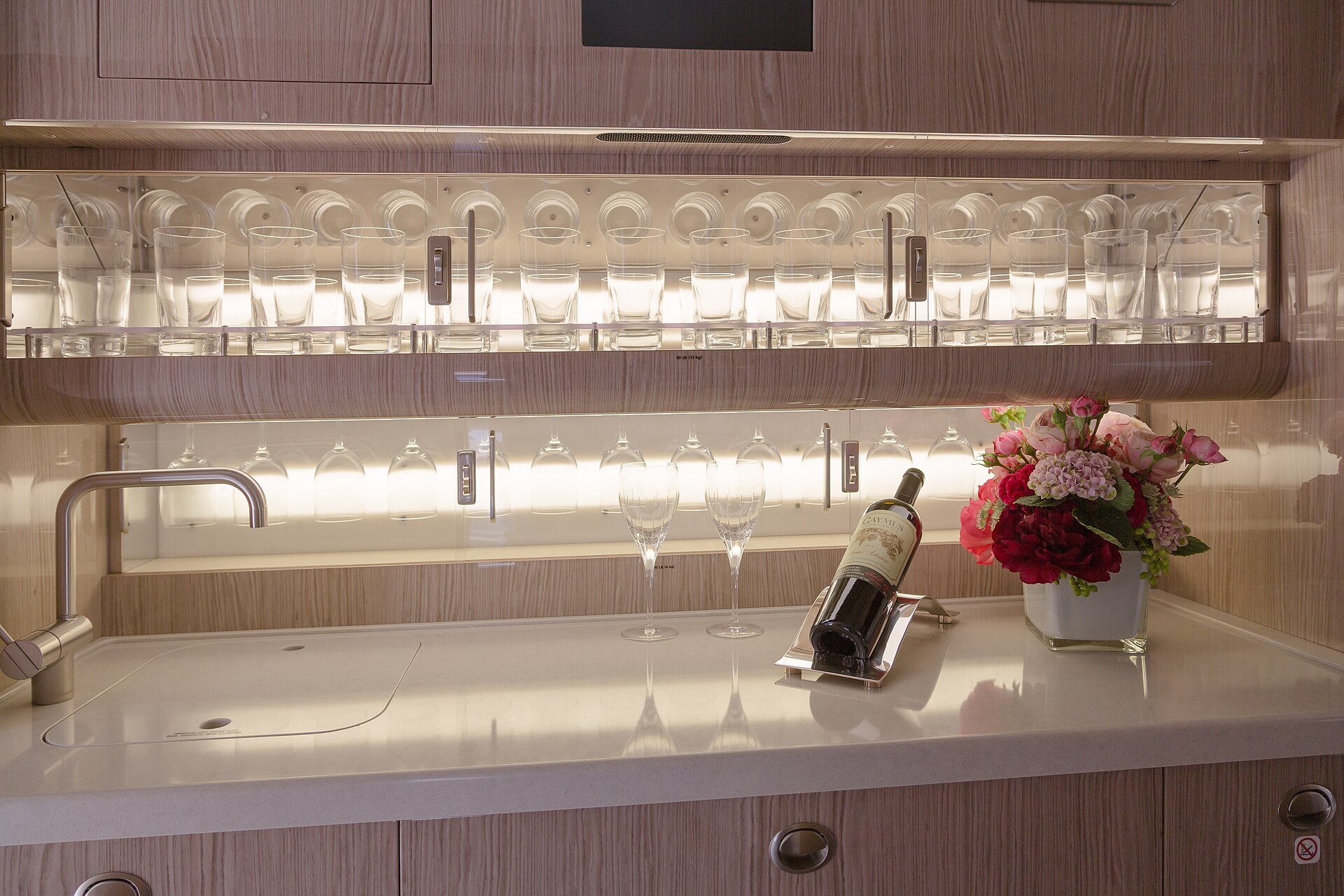
Drinks on Board: Wine, Champagne, Coffee and Water at Cabin Altitude
A pressurised cabin dulls sweetness, strips the fruit from light wines, flattens champagne faster and makes water boil below 100°C. What that means for the bar on a private jet, and the strict alcohol rules that apply to the crew.
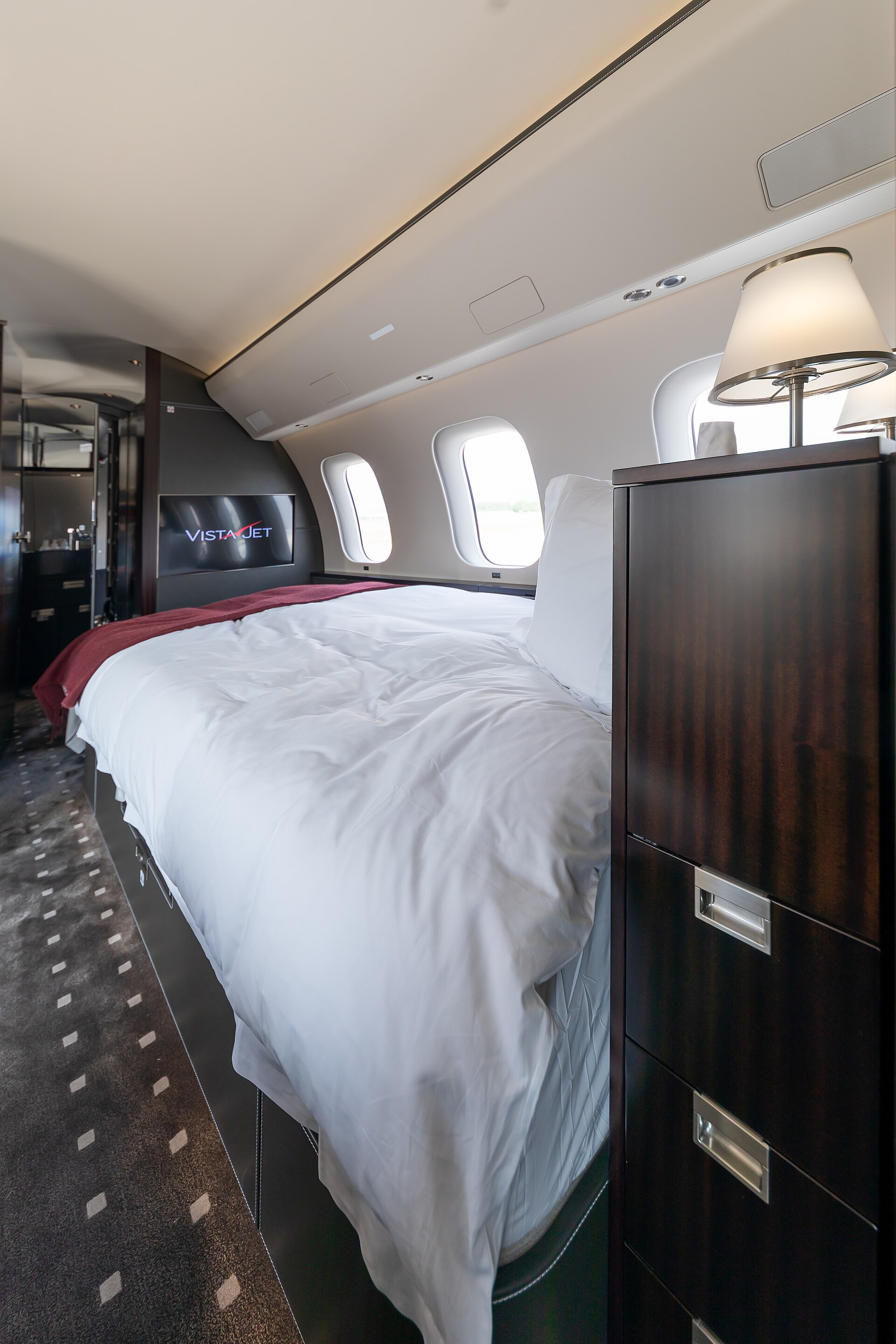
Sleeping on a Private Jet: Real Beds, Thinner Air and the Pilots Who Take Turns
Most private jets make beds out of seats. The largest now have fixed bedrooms, cabins pressurised below 3,000 feet and lights that imitate sunrise. What actually helps passengers sleep, and where the pilots rest on a 15-hour flight.