Why Private Jets Fly at 51,000 Feet
Airliners top out around 41,000 feet. Business jets routinely go 10,000 feet higher, into air a tenth as dense as sea level. The reasons are weather, traffic, fuel, and a view of the curve of the Earth.
By JetAtlas · Published 2026-05-12 · 7 min read · How we check facts
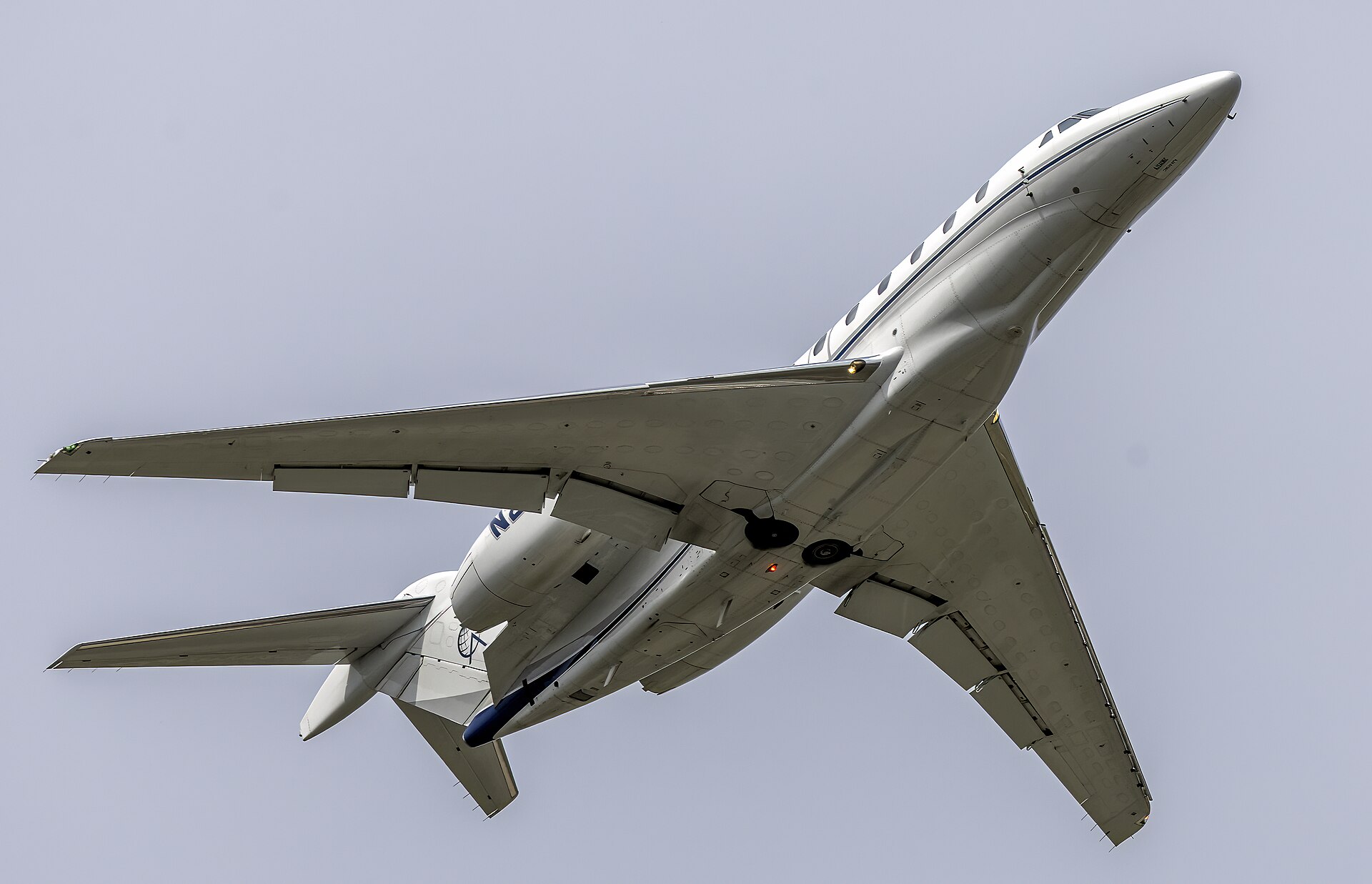
Look at a flight-tracking app over the Atlantic on any evening and you will see two layers of traffic. The airliners are stacked between 33,000 and 41,000 feet. Above them, sometimes 10,000 feet above them, a thinner scatter of Gulfstreams, Globals, and Falcons cruises at 45,000, 47,000, or 51,000 feet, where the sky is dark blue at noon and the air pressure is about a tenth of what it is at sea level.
The number 51,000 is not arbitrary. It is the certified ceiling of most ultra-long-range business jets (Gulfstream G650ER, G700, and G800; Bombardier Global 7500 and 8000; Dassault Falcon 7X, 8X, and 10X) and of a few smaller aircraft with big wings and strong pressurisation, including the Cessna Citation X. Here is why they go there, and why airliners do not.
The air gets thin, and that is the point
At sea level, air density is about 1.225 kilograms per cubic metre. At 41,000 feet it is about 0.29; at 51,000 feet, about 0.18. Thin air means less drag on the airframe, and less drag means less thrust is needed to hold speed. Engines also run more efficiently in cold air, and the outside temperature above the tropopause is a steady minus 56 degrees Celsius.
There is a catch. Wings need air to generate lift, so as density falls the aircraft must fly faster relative to the air to stay up. Meanwhile the speed of sound falls with temperature, so the aircraft's Mach number rises. Eventually the minimum speed to stay airborne and the maximum speed before shockwaves form on the wing converge into a narrow band pilots call the coffin corner. An aircraft's ceiling is set by where that band gets too narrow to be safe, and by how much thrust the engines can still make in thin air.
Business jets can go higher than airliners because they are, in aerodynamic terms, over-built. A Gulfstream G650ER has a wing designed for 7,500-nautical-mile range and engines that produce far more thrust than a typical cruise needs. An Airbus A320 is designed to carry 180 people cheaply between cities 500 miles apart and has no reason to carry the extra wing and structure to reach 51,000 feet.
| Altitude | Air pressure vs sea level | Density vs sea level | Typical users |
|---|---|---|---|
| 0 ft | 100% | 100% | Everyone |
| 35,000 ft | 24% | 31% | Airliners, most business jets |
| 41,000 ft | 18% | 24% | Airliner ceiling; light jets |
| 45,000 ft | 15% | 19% | Midsize and large business jets |
| 51,000 ft | 11% | 15% | Ultra-long-range business jets |
| 60,000 ft | 7% | 10% | Concorde (retired 2003), U-2 |
Figures from the International Standard Atmosphere, rounded.
Reason one: weather is below you
The tropopause, the boundary between the weather-bearing troposphere and the calm stratosphere, sits at about 36,000 feet in the mid-latitudes and higher in the tropics. Thunderstorms in the tropics can punch to 55,000 feet, but most convective weather tops out below 45,000. An aircraft at 49,000 feet is above almost all of it, and above much of the clear-air turbulence associated with the jet stream, which is strongest just below the tropopause.
Pilots of large-cabin jets talk about this in practical terms: a smooth ride for the boss and a straight line across a front that airliners are picking their way around. What sits below a jet at 49,000 feet:
- Nearly all cloud and precipitation, which rarely extends above the tropopause outside the tropics
- The core of the jet stream, and most of the clear-air turbulence that comes with it
- Icing, which needs liquid water and cannot occur at minus 56 degrees Celsius
- Every scheduled airliner, since none is certified above 43,000 feet
Reason two: nobody else is up there
Air traffic control separates aircraft vertically by 1,000 feet. Between 33,000 and 41,000 feet on the North Atlantic tracks or the corridor from New York to Florida, every usable level is taken and controllers assign whatever is free. Above 41,000 feet, the sky empties. A Global 7500 requesting 47,000 feet almost always gets it, and often gets a direct routing as well, because there is nothing to sequence it against. On a transatlantic flight that can save 10 to 20 minutes and a few hundred kilograms of fuel.
Reason three: fuel
Higher is not always more efficient (climbing costs fuel, and a short flight never reaches the altitudes where the savings pay back), but on a long leg the arithmetic favours height. Manufacturers publish long-range cruise data showing fuel flow falling as altitude rises until the engines run out of thrust margin. For a G650ER, cruising at 51,000 feet instead of 41,000 feet reduces fuel burn by a meaningful single-digit percentage at the same Mach, which over a 13-hour flight is several hundred gallons.
Reason four: the cabin
Going high only works if the fuselage can hold the pressure. Cabin altitude is the effective altitude the passengers experience. Older airliners hold a cabin altitude of 8,000 feet; the Boeing 787 and Airbus A350 manage about 6,000 feet, which is why people feel better after a long flight in them.
Business jets go further. At 41,000 feet, the Gulfstream G700 holds a cabin altitude of 2,840 feet; Bombardier says the Global 8000 holds 2,691 feet, the lowest in production. Even at 51,000 feet, a G650ER cabin sits below 5,000 feet. This requires a pressure differential of about 10.7 psi across the fuselage skin, compared with roughly 8 to 9 psi on most airliners, which in turn requires a stronger, heavier, more expensive structure. It is one of the reasons a 19-seat business jet costs more than a 180-seat airliner.
Cabin pressure matters physiologically. At 8,000 feet cabin altitude, blood oxygen saturation drops noticeably and many passengers arrive with a headache and dry eyes; at 3,000 feet, most people notice nothing. The lower cabin altitude, together with 100 percent fresh (not recirculated) air on Gulfstreams, is what owners mean when they say they arrive rested.
What happens if the pressure fails
There is a reason pilots treat 51,000 feet with respect. If a cabin depressurised at that altitude, the time of useful consciousness without supplemental oxygen is in the region of 10 to 15 seconds. Regulators require crews above 41,000 feet to have quick-donning oxygen masks within reach, and on many operators one pilot wears the mask continuously above 45,000 feet. The emergency descent is a dramatic manoeuvre: idle power, speed brakes out, nose down, 6,000 feet per minute or more, down to 10,000 feet in under seven minutes. It is practised in the simulator every six months and almost never needed for real.
Reason five: the view
At 51,000 feet the sky overhead is a deep indigo, the horizon shows a faint curve, and you can see the layered edge of the atmosphere as a thin bright band. Pilots who have flown both say the difference between 41,000 and 51,000 is visible and slightly eerie: the sun is harsher, the ground is a map, and airliners pass thousands of feet below, leaving contrails you look down on.
Why not all business jets
Light jets like the Citation CJ3 and Phenom 300E are certified to 45,000 feet, and many midsize jets to 45,000 or 47,000. Their smaller wings and engines cannot make the extra height pay on short trips, and their pressurisation systems are built to a lower differential. The 51,000-foot club is a large-cabin, long-range club, with one famous exception: the Citation X, a super-midsize jet built for speed, whose big swept wing and powerful engines took it to 51,000 feet as a matter of course. It is also the altitude at which the Global 8000, the fastest business jet in service since December 2025, does its Mach 0.94 cruising.
Mentioned in this story
More insights

What luxury really means on a VIP airliner
A VIP airliner is not just a larger private jet. Its real luxury is measured in certified space, sleep, quiet systems, completion time, crew workflow and the ability to carry a household or delegation across oceans without turning the cabin into theatre.
Farnborough, Biggin Hill or Luton: choosing a London private jet airport
Compare the final ground destination, operating window, aircraft requirements and handling arrangements before choosing a London airport.
Teterboro, Westchester or Morristown: choosing a New York private jet airport
Compare the airport and ground destination together, then check handling, timing, noise requirements and a fallback before accepting a charter proposal.