Why business jets fly faster than airliners
The fastest business jets are not faster by accident. They trade fuel, cabin capacity and design complexity for minutes saved, higher cruise altitudes and a smaller passenger count whose time is often the main payload.
By JetAtlas · Published 2026-10-18 · 8 min read · How we check facts

A Bombardier Global 8000 can cross the North Atlantic at Mach 0.90 and still keep going for thousands of miles. Its certified top speed is Mach 0.95. A Boeing 787, one of the quicker modern airliners, plans long-range missions around Mach 0.85. A 737 MAX-based BBJ or Airbus ACJ320neo tops out at Mach 0.82, even with a private cabin inside.
That gap is the answer in miniature. Purpose-built business jets are designed around time. Airliners are designed around seats.
Faster, but not always
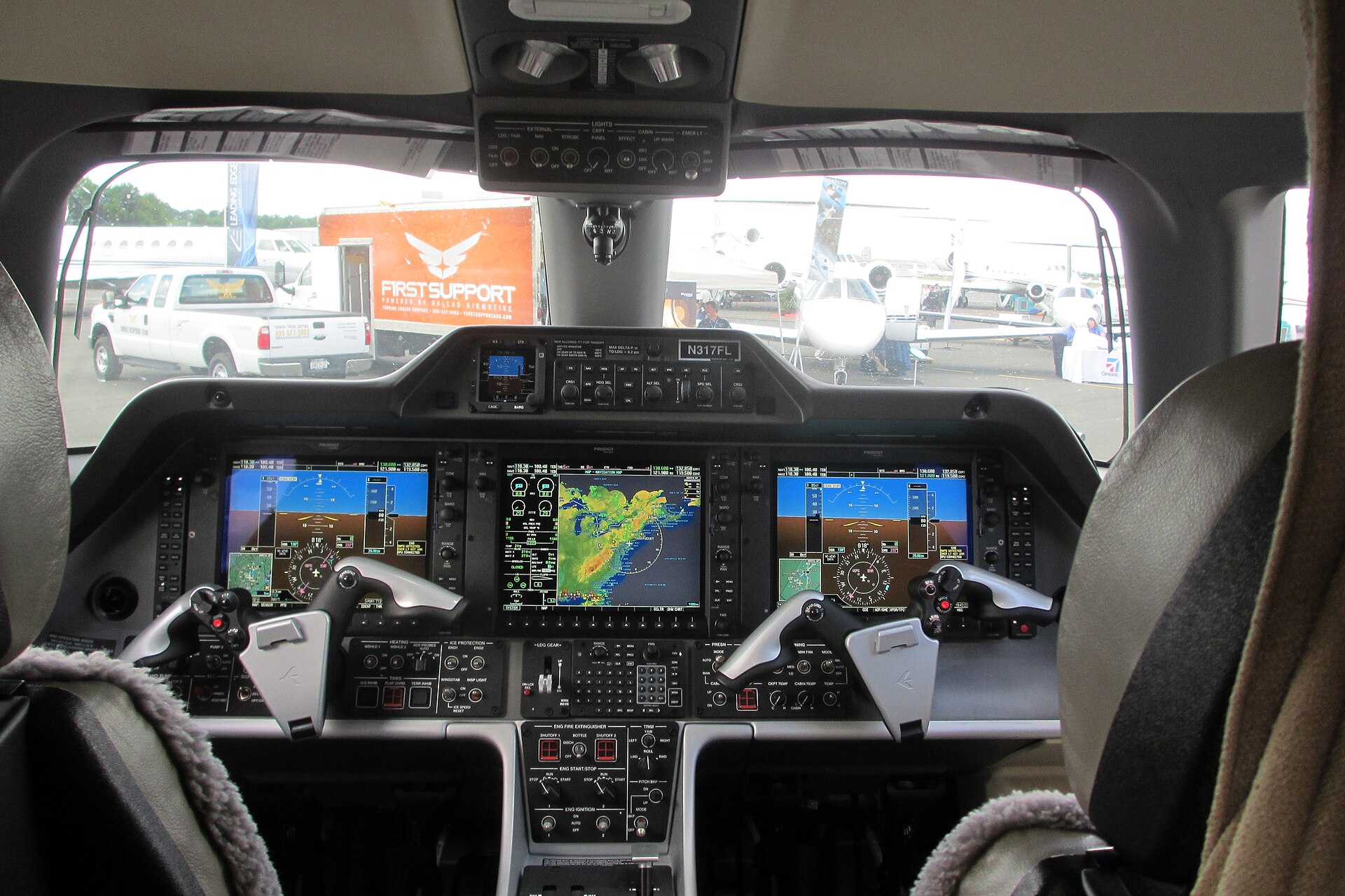
The phrase needs a guardrail: not every business jet is faster than every airliner. A light jet such as the Embraer Phenom 300E has a maximum Mach number of 0.80, close to the daily cruise speed of many narrowbody airliners. A converted airliner, such as a BBJ 737-8 or ACJ320neo, keeps the same basic speed limits as the commercial aircraft beneath the carpet and conference table.
The speed advantage belongs mostly to purpose-built midsize, super-midsize, large-cabin and ultra-long-range business jets. These aircraft tend to cruise in the high Mach 0.80s and, in the newest flagships, around Mach 0.90. Their maximum operating Mach numbers now reach levels that would have sounded extreme for civil aircraft after Concorde left service.
| Aircraft | Type | Max Mach | Max cruise | Ceiling | Typical passengers |
|---|---|---|---|---|---|
| Bombardier Global 8000 | Ultra-long-range jet | 0.95 | 540 kt | 51,000 ft | 13 |
| Gulfstream G700 | Ultra-long-range jet | 0.935 | 516 kt | 51,000 ft | 13 |
| Cessna Citation X+ | Super-midsize jet | 0.935 | 527 kt | 51,000 ft | 8 |
| Dassault Falcon 10X | Ultra-long-range jet | 0.925 | 516 kt | 51,000 ft | 12 |
| Embraer Phenom 300E | Light jet | 0.80 | 464 kt | 45,000 ft | 6 |
| Boeing BBJ 737-8 | Bizliner | 0.82 | 470 kt | 41,000 ft | 25 |
| Airbus ACJ320neo | Bizliner | 0.82 | 470 kt | 41,000 ft | 25 |
The numbers show the split. The smaller, purpose-built jets are shaped and powered for higher Mach numbers. The bizliners carry palatial cabins and airline roots, but their speed limits remain narrowbody-airliner speed limits.
The wing has to outrun the shock wave
A jet flying at Mach 0.85 is not in simple, slow air. Even though the airplane is below the speed of sound, parts of the airflow over the wing can locally accelerate to supersonic speed. Shock waves form. Drag climbs sharply. The airplane enters the transonic problem, where a few hundredths of a Mach number can mean a large fuel penalty.
NASA’s basic aerodynamics material describes wave drag as the drag associated with shock waves, and its transonic notes point out why swept wings are used on airliners: sweep delays the worst of the drag rise. Business jets use the same physics, but often with a different target. A wing meant to cruise happily at Mach 0.90 has to delay shock formation, control buffet and keep handling predictable near the edge of its operating envelope.
That drives visible design choices:
- thinner, highly swept wings on fast super-midsize and large-cabin jets;
- carefully shaped supercritical airfoils that manage pressure changes over the wing;
- area ruling and fuselage shaping to reduce transonic drag;
- powerful engines sized not just for takeoff, but for climb and high-altitude cruise;
- long flight-test campaigns to prove buffet margins and handling at high Mach.
The Citation X family made this obvious. It looked less like a conventional corporate jet and more like an arrow: long nose, sharply swept wing, engines hung far aft. Textron later had the Citation X+ verified at Mach 0.935, a speed it promoted as the fastest civil aircraft of its era. The airplane did not get there through thrust alone. Its whole shape was built around the transonic drag rise.
Airliners have a harsher bargain
An airline can fly faster. It usually chooses not to.
The reason is arithmetic. A scheduled airline spreads fuel burn, maintenance cost and engine life across 150 to 350 passengers. A small increase in cruise Mach can burn more fuel across every seat while saving only a few minutes on many routes. On a New York to Chicago sector, the climb, descent, taxi time, arrival sequencing and gate availability may matter more than an extra 30 knots in cruise.
Airliners are also network machines. They need low seat-mile cost, predictable block times, long engine intervals, good hot-and-high takeoff performance and runway compatibility across hundreds of airports. A wing optimized for Mach 0.90 would be expensive if it made low-speed handling, takeoff distance or fuel burn worse for everyday service.
The Boeing 787 is a useful comparison because it is a long-range airliner with a relatively fast cruise. Boeing’s airport-planning data uses Mach 0.85 for long-range cruise. That is quick for an airliner. Yet it is still below the Mach 0.90 high-speed cruise advertised for aircraft such as the Gulfstream G700 and G800.
Airlines also use cost index, a flight-management setting that balances fuel price against schedule value. When fuel is expensive or the airplane is early, the machine slows down. When connections, curfews or delays matter, it may speed up within approved limits. Business jet operators make the same calculation, but the value of the people in the cabin often pushes the answer toward speed.
Fewer seats change the equation
A Gulfstream G700 typically carries about 13 passengers in private service. A Bombardier Global 8000 is in the same range. An A320neo airline cabin may carry more than ten times that number.
That difference changes the design brief. A business jet does not need to move the lowest-cost seat from Denver to Orlando. It needs to move a small group directly, often between airports that airlines do not link nonstop. If the airplane can save 40 minutes in cruise, avoid a connection and land closer to the final destination, the trip may save half a working day.
On paper, speed alone looks modest. Over a 3,000 nm still-air cruise segment, an aircraft at 516 kt covers the distance in about 5 hours 49 minutes. At 470 kt, the same cruise segment takes about 6 hours 23 minutes. That is 34 minutes before wind, routing, climb and descent. The real gain comes when high cruise speed is combined with direct routing and smaller airports.
A business jet can leave when the passengers arrive, not when a schedule says boarding closes. It can use Teterboro instead of Newark, Farnborough instead of Heathrow, or Van Nuys instead of LAX, depending on the mission. The airplane’s speed matters, but its freedom from the airline network matters just as much.
Higher cruise altitudes help
Many fast business jets are certified to 51,000 feet. Most modern airliners spend their working lives lower, often in the 30,000s and low 40,000s, depending on weight, temperature and route. The FAA’s RVSM rules cover the dense band from FL290 to FL410, where aircraft are separated vertically by 1,000 feet if approved. Above that, the traffic picture changes.
Flying higher can reduce weather exposure and congestion. It also places the jet in colder, thinner air. Thinner air reduces drag, though engines make less thrust and wings must still produce lift. A lightly loaded business jet with a high thrust-to-weight ratio can step quickly into altitudes that a heavy airliner may not reach until late in a long flight.
That does not mean higher is always faster. At very high altitude, the margin between low-speed buffet and high-speed buffet narrows. Pilots call this the coffin corner in its extreme form. Modern flight-management systems, autothrottles and envelope protections help crews stay inside the safe band. The useful point is simpler: a business jet built for high-altitude cruise has more room to choose a fast, smooth level above much of the airline stream.
The latest speed race is still subsonic
The fastest current business jets remain below Mach 1 in normal operation. Supersonic business travel keeps attracting money and headlines, but the certified products in service are still transonic jets.
That has not stopped a new speed contest at the top of the market. Bombardier celebrated entry into service of the Global 8000 in December 2025, with a stated top speed of Mach 0.95 and 8,000 nm range. Gulfstream’s G800 earned FAA and EASA certification in April 2025 with increased performance: up to 8,200 nm at Mach 0.85, 7,000 nm at Mach 0.90 and a maximum operating Mach number of 0.935. The G700 sits close behind, also at Mach 0.935.
These numbers are not cruise settings for every day and every trip. Operators still care about fuel stops, reserves, winds, maintenance and engine life. Long-range cruise may be Mach 0.85. High-speed cruise may be Mach 0.90. Maximum operating Mach is a limit, not a timetable.
Still, the pattern is clear. Airliners slowed down after the first jet age because fuel and seat cost mattered more than glamour. Business jets kept chasing speed because the cabin is small, the passengers are few and the airplane is often bought to turn distance into time. At 51,000 feet, with the barber pole close and the Atlantic sliding under the nose, a few hundredths of Mach are not trivia. They are the reason the wing was drawn that way.
Sources
Mentioned in this story
More insights

What luxury really means on a VIP airliner
A VIP airliner is not just a larger private jet. Its real luxury is measured in certified space, sleep, quiet systems, completion time, crew workflow and the ability to carry a household or delegation across oceans without turning the cabin into theatre.
Farnborough, Biggin Hill or Luton: choosing a London private jet airport
Compare the final ground destination, operating window, aircraft requirements and handling arrangements before choosing a London airport.
Teterboro, Westchester or Morristown: choosing a New York private jet airport
Compare the airport and ground destination together, then check handling, timing, noise requirements and a fallback before accepting a charter proposal.