How Fast Are Private Jets? Mach 0.94, the Citation X Story, and Why the Fastest Isn't the Most Popular
The fastest business jet in service cruises at Mach 0.94, faster than any airliner since Concorde. But the aircraft that owned the speed title for 20 years sold modestly and was quietly retired. Speed, it turns out, is a strange thing to sell.
By JetAtlas · Published 2026-07-07 · 7 min read · How we check facts
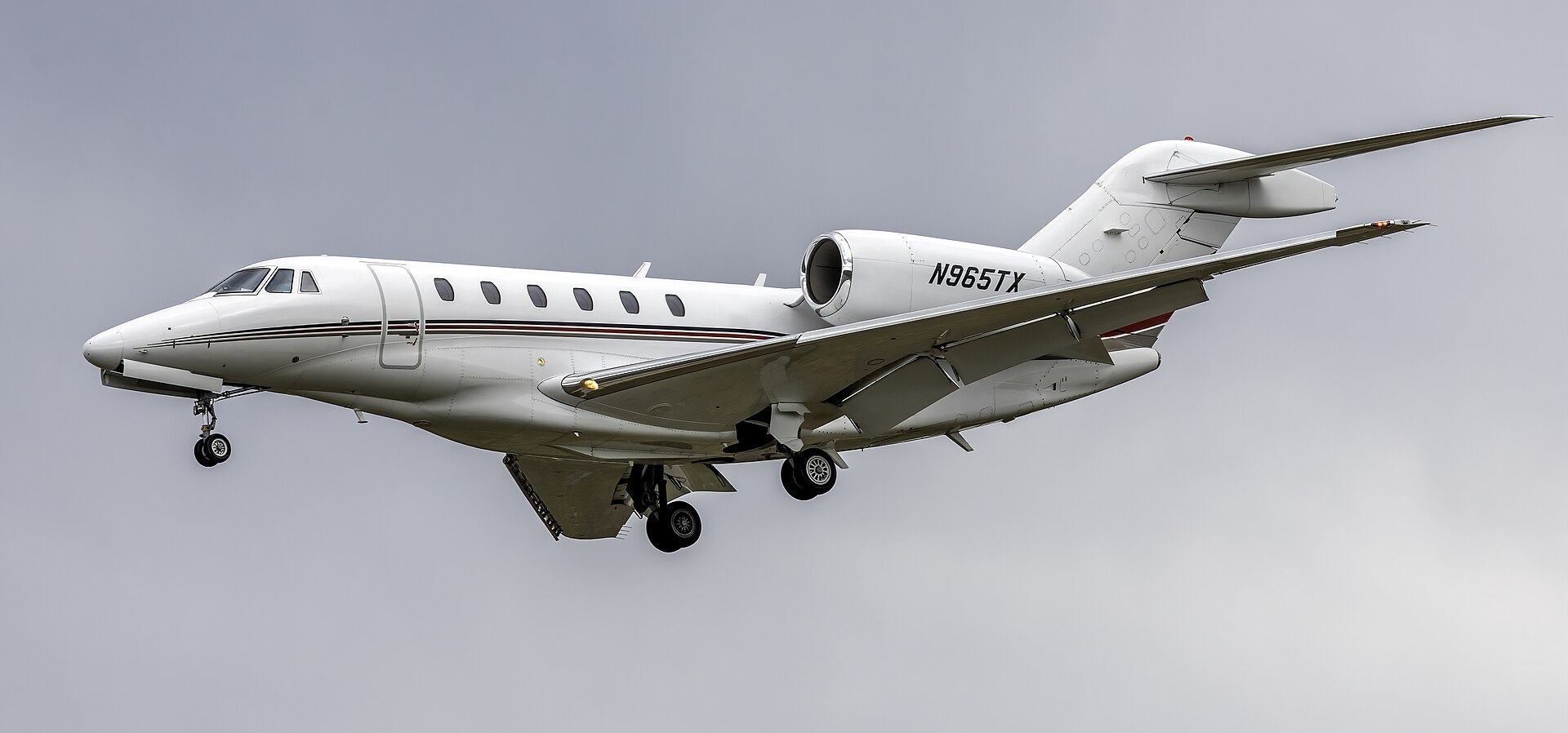
In December 2025 Bombardier delivered the first Global 8000, a 19-passenger jet certified to cruise at Mach 0.94, and called it the fastest civil aircraft since Concorde. The claim is correct. It is also the latest chapter in a 30-year story about a title that the industry has always wanted and never quite known what to do with.
What Mach 0.94 means
Mach number is speed relative to the speed of sound, which varies with temperature. At cruising altitudes above 36,000 feet, where the outside air is a steady minus 56 degrees Celsius, the speed of sound is about 573 knots (660 mph). So:
| Aircraft | Maximum operating Mach | True airspeed at altitude | Approx. mph |
|---|---|---|---|
| Airbus A320 (airliner) | 0.82 | 470 kt | 540 |
| Boeing 787 (airliner) | 0.90 | 516 kt | 594 |
| Embraer Phenom 300E (light jet) | 0.80 | 458 kt | 527 |
| Gulfstream G650ER | 0.925 | 530 kt | 610 |
| Cessna Citation X+ | 0.935 | 536 kt | 617 |
| Gulfstream G700 and G800 | 0.935 | 536 kt | 617 |
| Bombardier Global 8000 | 0.94 | 539 kt | 620 |
| Concorde (retired 2003) | 2.04 | 1,170 kt | 1,350 |
True airspeeds are calculated at ISA conditions above the tropopause and rounded.
Two things stand out. First, the whole modern business-jet fleet sits in a narrow band: the difference between the fastest and a good airliner is about 25 knots, or 4 percent. Second, the difference between Mach 0.935 and Mach 0.94, which manufacturers fight over in press releases, is about 3 knots. On a 3,000-nautical-mile flight, it is three minutes.
Note that maximum operating Mach is a limit, not a habit. Most flights are flown at long-range cruise, Mach 0.85 to 0.90 on a large-cabin jet, because fuel burn rises steeply near the limit. A G700 at Mach 0.85 has a range of 7,750 nautical miles; at Mach 0.90 it drops to 7,500.
The Citation X: the jet that owned the title
For most of the last 30 years the fastest business jet was not a Gulfstream or a Global. It was a Cessna.
The Citation X first flew on 21 December 1993 and entered service in 1996, and it was a deliberate provocation. Cessna's Citations were known as reliable, slow, and cheap; pilots joked about "Slowtations". The X was the opposite: a 37-degree swept wing, two Rolls-Royce AE 3007 engines built for a regional airliner, and a certified speed of Mach 0.92. Golfer Arnold Palmer took delivery of the first one and used it to set a round-the-world speed record for its class. In 2014 the improved Citation X+ pushed the limit to Mach 0.935.
It won the title and held it for two decades. Then, in 2018, Cessna ended production after 339 aircraft. For comparison, Cessna built more than 600 Citation XLS-series aircraft in the same period, and Embraer has delivered over 800 Phenom 300s, a light jet that cruises at Mach 0.80.
Why speed did not sell
The Citation X's problem was that it was a super-midsize jet with a midsize cabin. At 5 feet 6 inches wide and 5 feet 8 inches high, the cabin was narrower than the Challenger 300 and Gulfstream G280 that competed for the same customers, and it burned noticeably more fuel to go about 8 percent faster. On a typical 1,000-nautical-mile trip, the X saved roughly 12 to 15 minutes over a Challenger. Buyers looked at the trade and chose the wider cabin.
This is the pattern across the industry. Speed is a feature people ask about at the show and do not pay for at the contract signing, for four reasons:
- Time saved is small. On the routes most business jets fly, under two hours, the difference between Mach 0.80 and Mach 0.92 is 10 minutes. The 15 minutes saved at the FBO matter more.
- Fuel burn rises sharply. Drag increases steeply as an aircraft approaches Mach 1, so the last few hundredths of Mach cost disproportionately. Operators flying a G650 at Mach 0.90 rather than 0.85 pay 10 to 15 percent more in fuel for a few percent more speed.
- Air traffic control sets the pace. On busy routes, controllers slow fast aircraft to fit them behind slower ones. A Global 8000 arriving into London in the morning peak will be sequenced behind an A320.
- Cabins sell aircraft. The customers who can afford a fast jet are the customers who want a wide, quiet cabin, and that is where manufacturers put their engineering budget.
Why manufacturers chase it anyway
If speed does not sell, why did Bombardier spend a decade and hundreds of millions of dollars pushing the Global 8000 from Mach 0.925 to Mach 0.94? Partly because it could: the Global 7500 airframe turned out to have margin, and in May 2021 a test aircraft, flying with a NASA F/A-18 chase plane, briefly exceeded Mach 1.015 in a dive, becoming the first business jet to go supersonic on purpose. Certifying Mach 0.94 was a matter of proving the structure and control laws could handle it.
Mostly, though, speed is a marketing asset. "Fastest business jet" is a headline; "third-widest cabin" is not. Gulfstream reached Mach 0.925 with the G650 in 2012, matched the Citation X at Mach 0.935 with the G700 and G800, and Bombardier took the title back with the 8000. Each time, the advantage is measured in single-digit knots and in press coverage.
Fast enough: what pilots actually fly
Ask a Gulfstream or Global pilot what speed they fly and the answer is usually the same: the speed the boss asked for. Long-range cruise (Mach 0.85 on a G650, Mach 0.85 on a Global) for the long legs where fuel and range matter; high-speed cruise (Mach 0.90 or a bit more) when someone in the back has a meeting. Flying at the maximum is rare, both because the fuel penalty is large and because the ride at the edge of the envelope can be slightly less smooth.
For a light jet owner, the question barely arises. A Phenom 300E does Mach 0.80 and nobody minds, because a 400-mile trip takes an hour whether you go at Mach 0.80 or Mach 0.85, and the fuel saving pays for lunch.
The supersonic footnote
The obvious question is why there is no supersonic business jet. Several have been proposed; Aerion's AS2 got as far as a Boeing partnership and an order book before the company folded in 2021, and Spike and others continue to court investors. The obstacles are sonic-boom rules that ban overland supersonic flight in most countries, fuel burn that would make a Mach 1.4 jet three times as thirsty as a G700, and engines that do not exist. NASA's X-59 quiet-boom demonstrator, which flew in 2025, may eventually change the rules. Until then, Mach 0.94 is the ceiling, and the industry's honest position is that it is fast enough.
Mentioned in this story
More insights

What luxury really means on a VIP airliner
A VIP airliner is not just a larger private jet. Its real luxury is measured in certified space, sleep, quiet systems, completion time, crew workflow and the ability to carry a household or delegation across oceans without turning the cabin into theatre.
Farnborough, Biggin Hill or Luton: choosing a London private jet airport
Compare the final ground destination, operating window, aircraft requirements and handling arrangements before choosing a London airport.
Teterboro, Westchester or Morristown: choosing a New York private jet airport
Compare the airport and ground destination together, then check handling, timing, noise requirements and a fallback before accepting a charter proposal.